
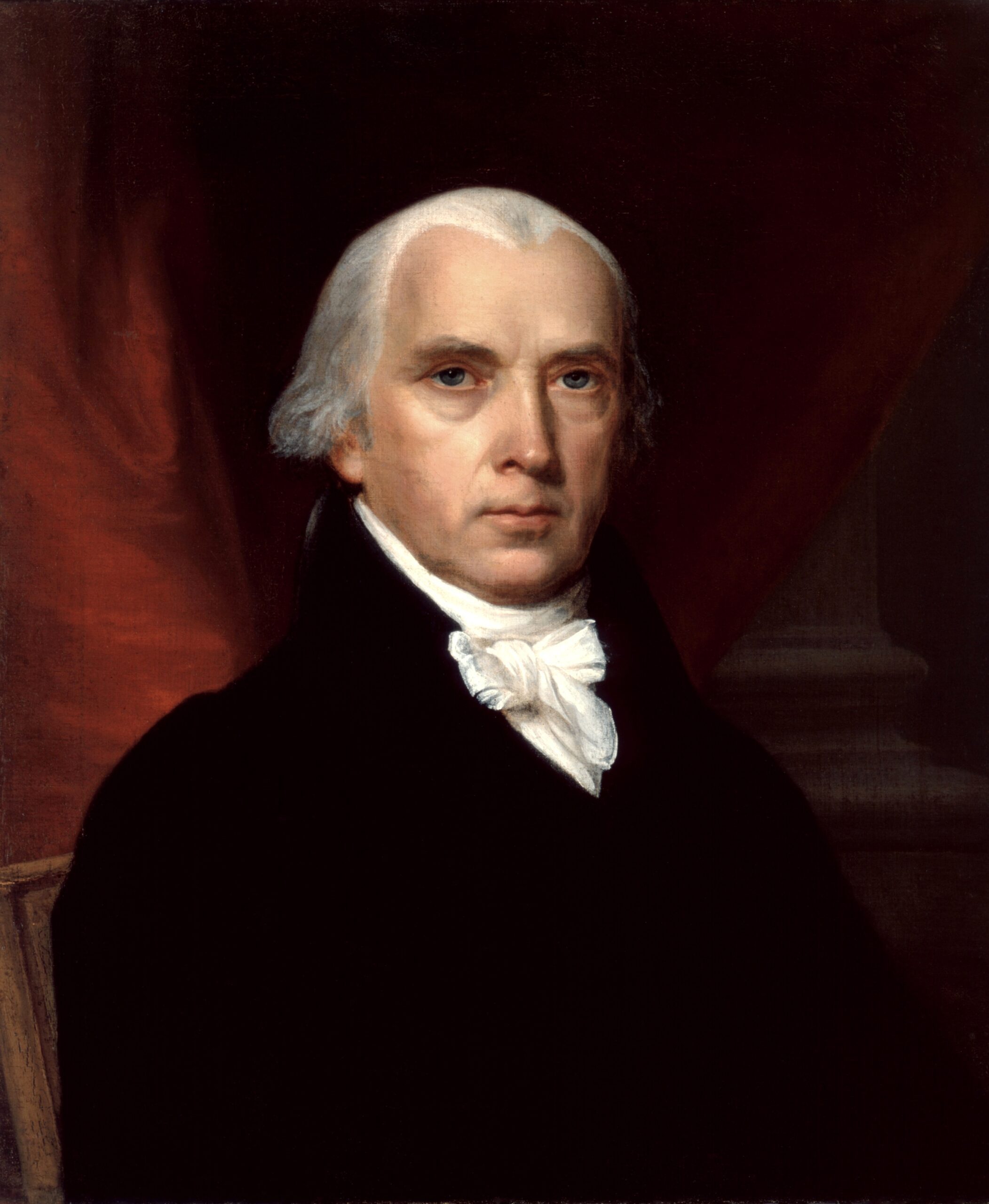
Brief Introduction of James Madison
James Madison, an American statesman and Founding Father, served as the fourth president of the United States from 1809 to 1817. He is widely hailed as the “Father of the Constitution” for his pivotal role in drafting and promoting the U.S. Constitution and the Bill of Rights. As a key architect of the foundational documents of the United States, his intellectual contributions and political leadership were instrumental in shaping the new republic. Madison’s work also extended to co-founding the Democratic-Republican Party and serving as Secretary of State under Thomas Jefferson, during which he oversaw the Louisiana Purchase.

James Madison Overview
| Full Name | James Madison Jr. |
| Date of Birth | March 16, 1751 |
| Birthplace | Port Conway, Virginia |
| Date of Death | June 28, 1836 |
| Place of Death | Montpelier, Orange County, Virginia |
| Parents | James Madison Sr. and Eleanor “Nelly” Conway Madison |
| Spouse | Dolley Payne Todd Madison |
| Children | One adopted son, John Payne Todd |
| Height | 5 feet 4 inches |
| Profession | Statesman, Diplomat, Founding Father, Planter |
| Political Party | Democratic-Republican |
| Known For | “Father of the Constitution,” Fourth U.S. President |
Early Life and Education of James Madison
James Madison was born on March 16, 1751, at Belle Grove plantation near Port Conway, Virginia, to a prosperous family of tobacco planters. The eldest of twelve children, he grew up at the family estate, Montpelier, in Orange County, Virginia. His parents, James Madison Sr. and Nelly Conway Madison, were prominent members of the Virginia gentry. The family’s wealth and status were built upon their extensive landholdings and the labor of enslaved people.
From a young age, Madison was a dedicated and inquisitive student. Between the ages of 11 and 16, he studied under Donald Robertson, a Scottish teacher who tutored the children of prominent Southern families. Under Robertson’s tutelage, Madison became proficient in Latin, mathematics, geography, and modern languages. He later returned to Montpelier to prepare for college under the guidance of the Reverend Thomas Martin.
In 1769, Madison enrolled at the College of New Jersey, now known as Princeton University. He chose Princeton over the more common choice for Virginians, the College of William and Mary, in part due to concerns about the humid climate’s effect on his health. At Princeton, he immersed himself in his studies, completing the four-year course in just two years and graduating in 1771. He remained for an additional year to study Hebrew and political philosophy under the university’s president, John Witherspoon, making him Princeton’s first graduate student.
James Madison’s Career
Early Political Career
After completing his studies, James Madison’s entry into politics was a natural progression for a man of his intellect and standing. He began his career in local politics, serving on the Orange County Committee of Safety in 1774. In 1776, he was elected as a delegate to the Virginia Convention, where he contributed to the drafting of the Virginia Declaration of Rights. During this time, he began a lifelong friendship and political collaboration with Thomas Jefferson.
Madison’s political influence grew as he served in the Virginia House of Delegates and the Continental Congress. He became known for his meticulous preparation and deep understanding of political theory and history. One of his early legislative successes was his work to pass the Virginia Statute for Religious Freedom, a landmark piece of legislation originally drafted by Jefferson.
Father of the Constitution
Dissatisfied with the weak national government established by the Articles of Confederation, Madison became a leading advocate for a new constitution. His extensive research into the history of governments prepared him for a central role at the Constitutional Convention of 1787. He arrived in Philadelphia with a detailed proposal known as the Virginia Plan, which provided the basic framework for the U.S. Constitution. His active participation in the debates and his comprehensive notes on the proceedings have earned him the title “Father of the Constitution.”
Following the convention, Madison, along with Alexander Hamilton and John Jay, authored a series of 85 essays known as The Federalist Papers. These essays were instrumental in persuading the American people to ratify the new Constitution by explaining how the proposed government would operate and why it was necessary.
Congressman and Secretary of State
Elected to the U.S. House of Representatives in 1789, Madison was a key advisor to President George Washington. One of his most significant accomplishments in Congress was drafting and introducing the first ten amendments to the Constitution, which became known as the Bill of Rights. These amendments were crucial for securing individual liberties and gaining the support of those who had initially opposed the Constitution.
During the 1790s, political divisions emerged, and Madison, alongside Thomas Jefferson, co-founded the Democratic-Republican Party in opposition to the Federalist Party’s policies. When Jefferson became president in 1801, he appointed Madison as his Secretary of State. In this role, Madison oversaw the Louisiana Purchase in 1803, which doubled the size of the United States.
Presidency and the War of 1812
James Madison was elected the fourth President of the United States in 1808 and was re-elected in 1812. His presidency was largely defined by escalating tensions with Great Britain, which led to the War of 1812. The war was a significant challenge for the young nation, and Madison faced considerable opposition. The conflict saw both defeats, including the burning of Washington, D.C., and significant victories that fostered a sense of national pride and unity. Many Americans viewed the war as a “second war of independence” that solidified the nation’s sovereignty.
James Madison Personal Life & Family
On September 15, 1794, James Madison married Dolley Payne Todd, a young and vivacious Quaker widow. Dolley’s outgoing personality was a perfect complement to Madison’s reserved nature. She became a celebrated hostess in Washington society and helped to define the role of the First Lady. The Madisons had a close and affectionate marriage that lasted over four decades.

James Madison had no biological children, but he adopted Dolley’s son from her first marriage, John Payne Todd. The family’s primary residence was Montpelier, the Madison family’s plantation in Orange County, Virginia. Like many of his contemporaries, Madison was a slave owner throughout his life, and the operation of Montpelier relied on the labor of over one hundred enslaved African Americans.
Awards and Achievements of James Madison
While formal awards in the modern sense were not common during his lifetime, James Madison’s achievements are recognized through various honors and memorials. Several universities and institutions are named in his honor, and there are awards that bear his name, recognizing contributions to public service and freedom of information.
| Accomplishment/Honor | Description |
|---|---|
| Father of the Constitution | For his principal role in drafting the U.S. Constitution. |
| Author of the Bill of Rights | For drafting and championing the first ten amendments to the Constitution. |
| Co-author of The Federalist Papers | For his contributions to the essays that were crucial for the ratification of the Constitution. |
| Fourth U.S. President | Led the nation through the War of 1812. |
| Secretary of State | Oversaw the Louisiana Purchase, significantly expanding U.S. territory. |
| Co-founder of the Democratic-Republican Party | Played a key role in establishing the nation’s first opposition political party. |
James Madison Net Worth and Income
Assessing the net worth of historical figures like James Madison in modern terms is challenging. His wealth was primarily tied to his ownership of the Montpelier plantation, which consisted of thousands of acres of land, and the enslaved people who worked on it. His income came from the plantation’s agricultural output, primarily tobacco. Throughout his life, however, Madison often struggled with debt due to the fluctuating agricultural market and the expenses of maintaining his estate and public life.
Legacy and Influence
James Madison’s legacy is profound and enduring. His contributions to the formation of the United States government have shaped the course of American history. As the chief architect of the Constitution, he designed a framework for a balanced federal government with a system of checks and balances that has lasted for over two centuries. His advocacy for the Bill of Rights ensured that the protection of individual liberties would be a cornerstone of American democracy.
Madison’s political thought continues to be studied by scholars and influences legal and political debates today. His commitment to republican principles, religious freedom, and a government accountable to the people remains a central part of the American political identity. However, his legacy is also complicated by his lifelong ownership of enslaved people, a contradiction that he and the nation have had to confront.
Interesting Facts about James Madison
- At five feet four inches tall, James Madison was the shortest president in U.S. history.
- He was the first graduate student at Princeton University.
- Madison and his rival, Patrick Henry, had a long-standing political rivalry that shaped Virginia politics.
- He initially opposed the inclusion of a Bill of Rights in the Constitution, believing it was unnecessary.
- Both of Madison’s vice presidents, George Clinton and Elbridge Gerry, died in office.
Controversies
The most significant controversy surrounding James Madison is his lifelong ownership of enslaved people. While he expressed private reservations about the institution of slavery, he never took significant action to abolish it, and his wealth was dependent on the labor of the enslaved. After his presidency, he became the president of the American Colonization Society, an organization that promoted the idea of sending free African Americans to a colony in Africa, a position that is widely criticized today.
His decision to lead the country into the War of 1812 was also controversial at the time. The war was divisive, particularly in New England, where it was referred to as “Mr. Madison’s War.” The conflict posed significant challenges to the young nation, including the burning of the White House and the Capitol by British forces.
Social Media Presence
As a historical figure from the 18th and 19th centuries, James Madison did not have a social media presence. However, numerous historical societies, museums, and educational institutions, such as James Madison’s Montpelier and the National Archives, maintain an online presence to share information about his life and work.
Final Words about James Madison
James Madison’s life was dedicated to the creation and preservation of the United States. His intellectual prowess and tireless work were fundamental to the establishment of the nation’s government and the protection of its citizens’ rights. While his legacy is viewed through the complex lens of his time, particularly concerning slavery, his contributions as a statesman, political theorist, and leader remain of paramount importance. Madison’s vision of a stable and enduring republic continues to shape the United States and serves as a testament to his profound impact on American history.