
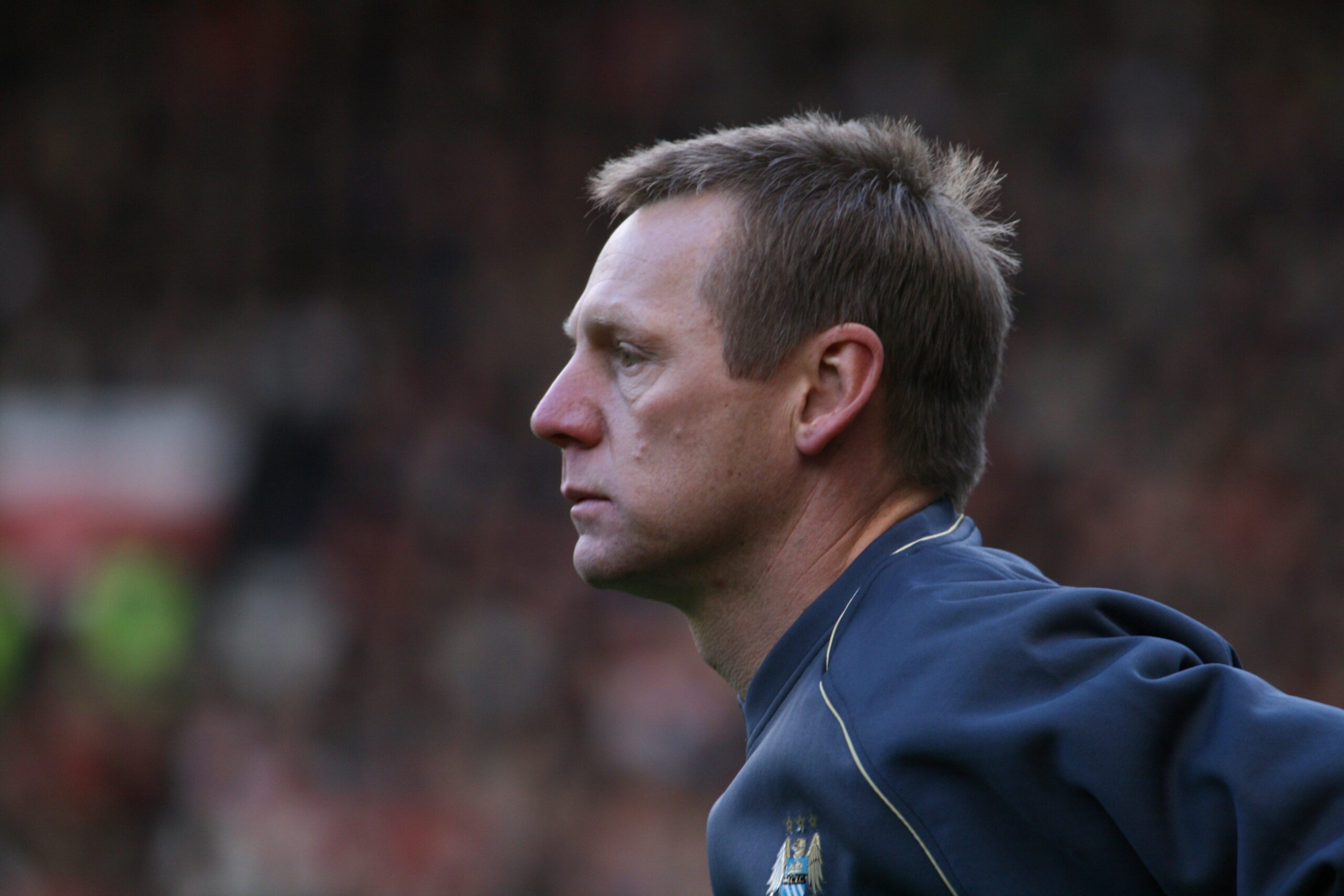
Brief Introduction of Stuart Pearce
Stuart Pearce, MBE, is one of English football’s most iconic and beloved figures, revered for his ferocious competitiveness and unwavering passion on the pitch. Nicknamed “Psycho” for his intense and unforgiving style of play, Pearce carved out a remarkable career as a left-back, most notably with Nottingham Forest, and as a stalwart for the England national team. His journey from a non-league player and qualified electrician to a top-flight captain and international hero is a testament to his dedication and resilience. Pearce’s career is famously defined by moments of immense pressure, including his penalty miss in the 1990 World Cup semi-final and his cathartic, roaring redemption at Euro ’96, an image that has become legendary in football folklore. After retiring as a player, he transitioned into management, taking the helm at Manchester City, the England U21s, and the Great Britain Olympic team.

Stuart Pearce Overview
| Full Name | Stuart Pearce |
| Date of Birth | 24 April 1962 |
| Age(as of 2025) | 63 |
| Birthplace | Shepherd’s Bush, London, England |
| Profession | Football Manager, former Professional Football Player, Pundit |
| Husband/Wife | Formerly married to Liz Cox (1993-2013). Currently in a relationship with Carol Day. |
| Family | Parents: Not publicly detailed. Siblings: Two brothers, Dennis and Ray, and a sister, Pamela. Children: One daughter, Chelsea, and one son, Harley (deceased). |
| Relationship/Affairs(GF/BF) | In a long-term relationship with Carol Day. |
| Net Worth | Estimated between £5 million and £10 million. |
Early Life and Education of Stuart Pearce
Stuart Pearce was born on April 24, 1962, in Shepherd’s Bush, London, the youngest of four children. He grew up with two older brothers, Dennis and Ray, and a sister, Pamela. His early education took place at Fryent Primary School in Kingsbury, North West London, before he attended Claremont High School in Kenton. From a young age, Pearce displayed the tenacity that would define his later career. His journey into football was unconventional for a future international star. After being rejected in a trial with Queens Park Rangers and an application to Hull City, he began his playing career in the non-leagues with Wealdstone. Balancing his passion for football, he also trained and worked as a qualified electrician, a trade he famously continued to advertise even after turning professional, highlighting his grounded and uncertain perspective on a future in the sport.
Stuart Pearce’s Career
Early Career and Rise to Prominence
Pearce’s professional career began in earnest when Coventry City, managed by Bobby Gould, signed him from Wealdstone in 1983 for a fee of £30,000, a significant sum for a non-league player at the time. He quickly established himself as a tough-tackling, reliable left-back. His performances caught the eye of the legendary manager Brian Clough, who brought him to Nottingham Forest in 1985 for £300,000 in a deal that also included defender Ian Butterworth. It was at the City Ground that Pearce’s career truly flourished and he would become a club icon.
Nottingham Forest and “Psycho”
Over twelve years at Nottingham Forest, Pearce became the heart and soul of the team, serving as club captain for eleven of those years. His tenacious and aggressive style of play earned him the affectionate nickname “Psycho” from the Forest faithful, a moniker that would stick throughout his career. He made 401 league appearances for Forest, scoring an impressive 63 goals for a defender, many from his thunderous free-kicks and penalties. During his tenure, he won two League Cups (1989, 1990) and a Full Members Cup (1989). He was also part of the team that experienced the horror of the Hillsborough disaster during the 1989 FA Cup semi-final. A testament to his loyalty, Pearce remained with Forest after their relegation from the Premier League in 1993, helping them win promotion back to the top flight the very next season.
England Career: Heartbreak and Redemption
Pearce made his England debut in 1987 and went on to earn 78 caps, captaining the side on nine occasions. His international career is etched in the memory of a generation of football fans. The 1990 World Cup in Italy saw England reach the semi-finals, only to be knocked out by West Germany on penalties. Pearce, one of England’s most reliable players, had his penalty saved, and the image of his subsequent distress became iconic. Six years later, on home soil at Euro ’96, he faced his demons. In a quarter-final shootout against Spain, Pearce emphatically smashed his penalty into the net, wheeling away in a passionate, roaring celebration of pure catharsis that remains one of football’s most enduring images.
Later Playing Career
After a brief spell as player-manager at Forest, Pearce left in 1997 to join Newcastle United. With Newcastle, he reached two FA Cup finals and played in the Champions League. He then moved to West Ham United in 1999, where despite his advancing years, his performances were so impressive that he was named Hammer of the Year in 2001. His final season as a professional was with Manchester City, where, at the age of 40, he captained the team to the First Division championship in 2002, securing their promotion to the Premier League before retiring.
Managerial and Coaching Career
After hanging up his boots, Pearce transitioned into coaching, initially staying on at Manchester City under Kevin Keegan. In 2005, he was appointed manager, a role he held for two years. His most significant managerial role was with the England U21 team from 2007 to 2013. He guided the “Young Lions” to four consecutive European Championships, reaching the semi-finals in 2007 and the final in 2009. In 2012, he was given the honour of managing the Great Britain Olympic football team at the London Games. He also had a brief spell as caretaker manager of the senior England team for one match in 2012. Pearce has since had coaching roles at Nottingham Forest, Portsmouth, and West Ham United.

Stuart Pearce Personal Life & Family
Stuart Pearce was married to Liz Cox for twenty years, from 1993 to 2013. The couple had two children, a daughter named Chelsea and a son named Harley. Chelsea is an accomplished equestrian who has competed for Great Britain. Tragically, in October 2025, his son Harley died at the age of 21 in a tractor accident in Gloucestershire. The family released a statement expressing their profound heartbreak, describing Harley as a “golden boy with an infectious smile” who had a wonderful work ethic and entrepreneurial spirit in the farming industry. Pearce is currently in a long-term relationship with Carol Day, who has worked for the Football Association. Away from football, Pearce is a well-known fan of punk rock music and has been featured on the album cover of the band The Lurkers.
Awards and Achievements of Stuart Pearce
- League Cup Winner (with Nottingham Forest): 1988–89, 1989–90
- Full Members’ Cup Winner (with Nottingham Forest): 1988–89
- Football League First Division Champion (with Manchester City): 2001–02
- PFA Team of the Year: 1987–88, 1988–89, 1989–90, 1990–91, 1991–92
- Nottingham Forest Player of the Season: 1988–89, 1990–91, 1995–96
- Hammer of the Year (West Ham United Player of the Year): 2000–01
- Premier League Player of the Month: February 2001
- Appointed a Member of the Order of the British Empire (MBE): 1999
Stuart Pearce Net Worth and Income
As of recent estimates, Stuart Pearce’s net worth is believed to be between £5 million and £10 million. His wealth has been accumulated over a long and successful career in football, first as a high-profile player for clubs like Nottingham Forest, Newcastle, and Manchester City, and for the England national team. Following his playing career, he earned a substantial income as a manager for Manchester City, the England U21 team, and Nottingham Forest. In addition to his football earnings, Pearce is a regular media personality, working as a pundit and co-commentator for major broadcasters like talkSPORT. He is also a sought-after figure on the corporate speaking circuit, where he shares insights on leadership, motivation, and teamwork drawn from his extensive experiences in the sport.
Legacy and Influence
Stuart Pearce’s legacy in English football is that of a true warrior, a player who embodied the “bulldog spirit” through his commitment, passion, and unyielding desire to win. His nickname, “Psycho,” though seemingly aggressive, was a term of endearment from fans who admired his all-or-nothing approach. He remains a legendary figure at Nottingham Forest, where he is considered one of the club’s greatest ever players. For England, he is remembered not just for his 78 caps but for the raw emotion he displayed while representing his country, particularly his iconic penalty redemption at Euro ’96. This moment transcended sport, becoming a symbol of resilience and courage in the face of past failure. As a manager, he was instrumental in the development of a generation of young English players during his tenure with the U21s. Today, he continues to influence the game as a respected pundit, offering frank and insightful analysis.
Interesting Facts about Stuart Pearce
- Before his professional football career took off, Pearce worked as a qualified electrician and even advertised his services in Nottingham Forest’s matchday programme.
- He is a huge fan of punk rock music and has attended hundreds of gigs. His favourite band is The Stranglers, and he is pictured on the inside cover of an album by another punk band, The Lurkers.
- In 2016, at the age of 53, he briefly came out of retirement to play one match for Longford AFC, a non-league team dubbed “the worst in Great Britain,” to support the grassroots game.
- His brother, Ray, was a Football League linesman and once officiated a League Cup match in which Stuart was playing in 1986.
- He captained every team he played for from the age of 10 until he retired from professional football.
Controversies
Stuart Pearce’s career has been largely free of major controversy, with his reputation built on honesty and professionalism. However, during his time as Manchester City manager, his tenure was marked by some difficult periods. The team’s form declined significantly in his second full season, with the club setting a record for the fewest home goals scored in a top-flight season (just 10, with none after New Year’s Day 2007). The period also included a training ground fight between players Joey Barton and Ousmane Dabo, which added to the pressure on his management. He was subsequently dismissed by the club in May 2007.
Social Media Presence
- Instagram – Not publicly available
- Twitter – Not publicly available
- YouTube – Not publicly available
Final Words about Stuart Pearce
Stuart Pearce remains a prominent and highly respected figure in the world of English football. Though no longer on the touchline, his voice carries significant weight through his punditry work, where his direct and knowledgeable analysis is valued by fans and peers alike. His journey from an electrician in non-league football to an England captain and national icon is an enduring story of grit and determination. The legacy of “Psycho” is not just in the trophies he won or the goals he scored, but in the indelible image of a player who gave everything for his club and country. His passionate, roaring celebration at Wembley in 1996 will forever be a symbol of personal redemption and national pride, securing his place as one of England’s most unforgettable footballing heroes.