
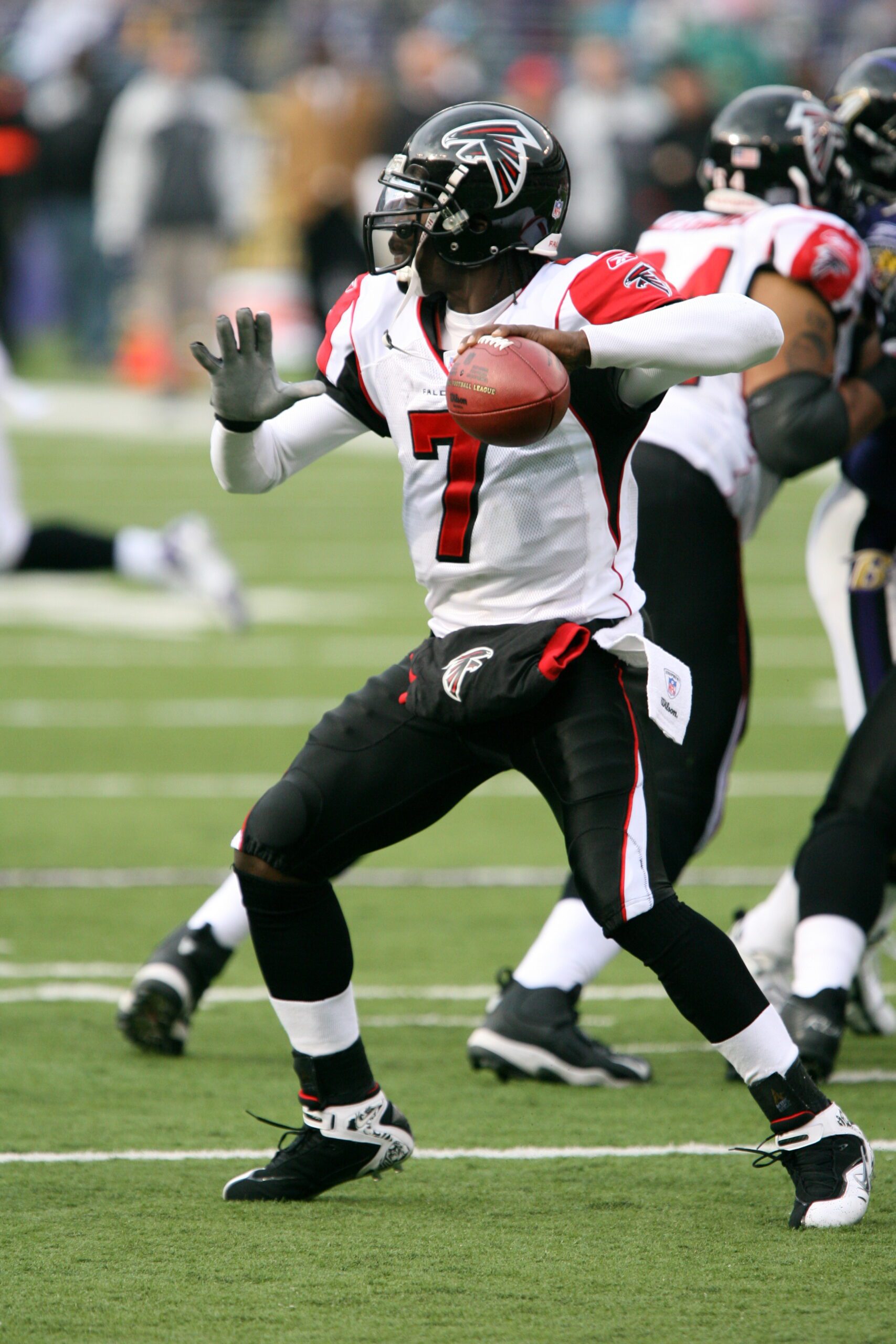
Brief Introduction of Michael Vick
Michael Dwayne Vick is a former American football quarterback who played in the National Football League (NFL) for 13 seasons. Vick was a revolutionary player, recognized for his exceptional speed, athleticism, and powerful arm, which redefined the quarterback position. He was the first African-American quarterback to be selected first overall in the NFL draft. His promising career with the Atlanta Falcons was brought to a halt in 2007 due to his conviction for involvement in an illegal dog fighting ring. After serving a federal prison sentence, he made a remarkable comeback with the Philadelphia Eagles, earning the NFL Comeback Player of the Year award in 2010. Vick retired as the league’s all-time leading rusher among quarterbacks, leaving a complex and influential legacy on the sport. Post-retirement, he has worked as an NFL analyst and has entered the world of coaching.

Michael Vick Overview
| Full Name | Michael Dwayne Vick |
| Date of Birth | June 26, 1980 |
| Age(as of 2025) | 45 |
| Birthplace | Newport News, Virginia, U.S. |
| Profession | Former Professional Football Player, Football Coach |
| Husband/Wife | Kijafa Vick (née Frink) |
| Family | Parents: Brenda Vick and Michael Boddie; Brother: Marcus Vick; Children: Mitez, Jada, London, Michael Jr. |
| Relationship/Affairs(GF/BF) | Tameka Taylor (former) |
| Net Worth | Estimated to be between $4 million and $16 million |
Early Life and Education of Michael Vick
Michael Dwayne Vick was born on June 26, 1980, in Newport News, Virginia, to teenage parents Brenda Vick and Michael Boddie. He was the second of four children and grew up in the Ridley Circle Homes, a public housing project in a neighborhood challenged by crime and poverty. His father, a sandblaster and spray-painter at the local shipyard who had played football in his youth, introduced Vick to the sport at the age of three. Vick’s athletic talents were evident from an early age, and he found refuge from the harsh realities of his environment in sports, particularly football. He often went fishing to escape the stresses of his neighborhood. Vick attended Homer L. Ferguson High School, where he began to showcase his exceptional abilities as a quarterback. After the school closed, he transferred to Warwick High School, following his coach, Tommy Reamon. Under Reamon’s guidance, Vick flourished, passing for 4,846 yards and 43 touchdowns while also rushing for 1,048 yards and 18 touchdowns during his high school career. A highly sought-after recruit, he chose to attend Virginia Tech.
Michael Vick’s Career
Michael Vick’s football career is a tale of extraordinary talent, a significant downfall, and a determined comeback. His journey began at Virginia Tech, where as a redshirt freshman in 1999, he led the Hokies to an undefeated regular season and a berth in the BCS National Championship Game. His electrifying play earned him numerous accolades, including the Archie Griffin Award as college football’s most valuable player, and he finished third in the Heisman Trophy voting.
Vick’s phenomenal college performance led to him being the first overall pick in the 2001 NFL Draft by the Atlanta Falcons, making him the first African-American quarterback to be selected with the top pick. He signed a six-year, $62 million contract. In Atlanta, Vick’s dual-threat capabilities revolutionized the quarterback position. He led the Falcons to the playoffs twice, including an appearance in the 2004 NFC Championship game, and was selected to three Pro Bowls during his six years with the team. In 2006, he became the first quarterback in NFL history to rush for over 1,000 yards in a single season.
This successful chapter was abruptly cut short in 2007 when Vick was indicted on federal charges related to a dog fighting ring. He pleaded guilty and was sentenced to 23 months in federal prison, leading to his suspension from the NFL and release by the Falcons.
After serving 18 months, Vick made a remarkable return to the NFL in 2009, signing with the Philadelphia Eagles. His 2010 season was one of the greatest comeback stories in sports history. He had his best statistical season, throwing for over 3,000 yards and 21 touchdowns, and was named the NFL Comeback Player of the Year, earning his fourth Pro Bowl selection. After his time with the Eagles, he had brief stints with the New York Jets and Pittsburgh Steelers, primarily as a backup, before officially retiring in 2017. Upon retirement, Vick held the record for the most career rushing yards by a quarterback in NFL history with 6,109 yards.
Michael Vick Personal Life & Family
Michael Vick’s personal life has been marked by both long-term commitment and the challenges of his public controversies. He is married to Kijafa Vick (née Frink), whom he wed in 2012. Their relationship has endured since 2002, and Kijafa was a supportive presence throughout his legal troubles and incarceration. Together, they have two daughters, Jada and London, and a son, Michael Jr. Kijafa has developed her own public presence, appearing on reality television shows such as “Baller Wives” and “The Michael Vick Project,” the latter of which documented Vick’s efforts to rehabilitate his image after prison.
Vick also has an older son, Mitez, from a previous relationship with Tameka Taylor. His children have pursued their own interests; his oldest daughter Jada is a talented flag football player who received a scholarship to play at Reinhardt University, while his son Mitez has embarked on a career in modeling and dancing.
Vick’s parents are Brenda Vick and Michael Boddie, who were teenagers when he was born. They married when Michael was around five years old. He also has a younger brother, Marcus Vick, who also played quarterback at Virginia Tech. Vick has spoken about the importance of family and the pain of being separated from them during his time in prison. He has credited his faith, instilled in him by his grandmother during his childhood, as a crucial element that helped him navigate his adversities.
Awards and Achievements of Michael Vick
- 4x Pro Bowl Selection (2002, 2004, 2005, 2010)
- NFL Comeback Player of the Year (2010)
- Bert Bell Award (2010)
- Archie Griffin Award (1999)
- ESPY Award – College Football Player of the Year (1999)
- First-team All-American (1999)
- Big East Offensive Player of the Year (1999)
- Big East Rookie of the Year (1999)
- Gator Bowl MVP (2000)
- College Football Hall of Fame (Inducted 2025)
- Virginia Tech Sports Hall of Fame (Inducted 2017)
Michael Vick Net Worth and Income
As of 2025, Michael Vick’s net worth is estimated to be between $4 million and $16 million. This figure represents a significant financial recovery after he filed for Chapter 11 bankruptcy in 2008 following his arrest and imprisonment. During his NFL career, Vick earned a total of approximately $116 million in salary from his contracts with the Atlanta Falcons, Philadelphia Eagles, New York Jets, and Pittsburgh Steelers. His most lucrative contract was a 10-year, $130 million extension he signed with the Falcons in 2004, which was the largest in league history at the time. However, he was later required to pay back nearly $20 million of his bonus to the Falcons following his legal troubles. After his comeback, he signed a significant five-year, $80 million contract with the Eagles. His income sources have diversified since his playing days, including a role as a studio analyst for FOX Sports and his current position as a head football coach. Court documents from 2012 revealed that a substantial portion of his post-prison earnings went toward paying taxes, creditors, and legal fees.

Legacy and Influence
Michael Vick’s legacy in the NFL is both profound and complex, marked by revolutionary talent and a deeply damaging controversy. On the field, he is widely credited with transforming the quarterback position. His unparalleled combination of a powerful throwing arm and extraordinary rushing ability made him the preeminent dual-threat quarterback of his era, forcing defensive coordinators across the league to devise new strategies to contain him. He broke the mold for what an NFL quarterback could be, paving the way for a future generation of mobile and athletic quarterbacks like Cam Newton, Russell Wilson, and Lamar Jackson. At the time of his retirement, he was the NFL’s all-time leading rusher for a quarterback.
However, Vick’s on-field legacy is inextricably linked to his 2007 conviction for operating a dog fighting ring, a crime that shocked the public and resulted in a significant prison sentence. This controversy irrevocably tarnished his public image and led to a temporary end to his football career. His subsequent return to the NFL and success with the Philadelphia Eagles is a powerful story of redemption for some, demonstrating resilience and the possibility of a second chance. For others, the cruelty of his crimes remains an unforgivable stain on his character. The case brought unprecedented national attention to the brutality of dog fighting, leading to stronger animal welfare laws and increased public awareness. Ultimately, Michael Vick’s influence is a dual narrative of a player who changed the game of football and a public figure whose actions off the field sparked a national conversation about animal cruelty and personal accountability.
Interesting Facts about Michael Vick
- Despite his fame as a left-handed quarterback, Michael Vick is naturally right-handed.
- Before his NFL career, Vick was drafted by the Colorado Rockies in the 30th round of the 2000 Major League Baseball draft, even though he hadn’t played baseball since his freshman year of high school.
- During his record-breaking 1999 season at Virginia Tech, he led the NCAA in passing efficiency, setting a new record for a freshman.
- In a 2010 game against the Washington Redskins, he became the first player in NFL history to pass for over 300 yards, rush for over 50 yards, throw four passing touchdowns, and run for two rushing touchdowns in a single game.
- His childhood nickname was “Ookie”.
- Vick is an avid fisherman, a hobby he took up at age 10 as a way to escape the pressures of his neighborhood.
- While serving his prison sentence, Vick played on the prison’s flag football team.
Controversies
The most significant controversy of Michael Vick’s life and career was his involvement in an illegal interstate dog fighting ring known as “Bad Newz Kennels,” which he operated from his property in Surry County, Virginia. An investigation beginning in April 2007 uncovered evidence of the brutal enterprise, including the housing and fighting of pit bull terriers. Vick and three other men were indicted on federal felony charges in July 2007. The indictment detailed a gruesome operation that involved not only the fighting of dogs but also the killing of underperforming animals through methods such as hanging and drowning. Vick initially pleaded not guilty but changed his plea in August 2007, admitting to conspiring to operate a dog fighting enterprise. In December 2007, he was sentenced to 23 months in federal prison. The NFL suspended him indefinitely without pay, and the Atlanta Falcons subsequently released him. The case garnered widespread public outrage and brought the issue of dog fighting to the forefront of national conversation, leading to strengthened animal cruelty laws. Vick also faced financial repercussions, including having to repay a significant portion of his signing bonus to the Falcons and eventually filing for bankruptcy in 2008.
Social Media Presence
- Instagram – Information not disclosed.
- Twitter – Information not disclosed.
- YouTube – Information not disclosed.
Final Words about Michael Vick
Michael Vick’s journey remains one of the most compelling and polarizing in modern sports history. From the heights of being an NFL superstar who revolutionized the game to the depths of a federal prison sentence, his life has been a study in contrasts. After his successful comeback with the Philadelphia Eagles, he concluded his playing career and transitioned into new roles, including serving as a television analyst for Fox Sports and embarking on a coaching career, most recently becoming the head coach for the Norfolk State Spartans. His story is a powerful narrative of immense talent, a grievous fall from grace, and a determined effort at redemption. While his on-field innovations have left a lasting mark on how the quarterback position is played, his name will forever be linked to the animal cruelty case that nearly ended his career. His legacy continues to be debated, serving as a complex example of athletic genius, personal failure, and the enduring possibility of a second chapter. Vick’s ongoing work in coaching and his continued public presence suggest a dedication to contributing to the sport and mentoring a new generation of athletes.