
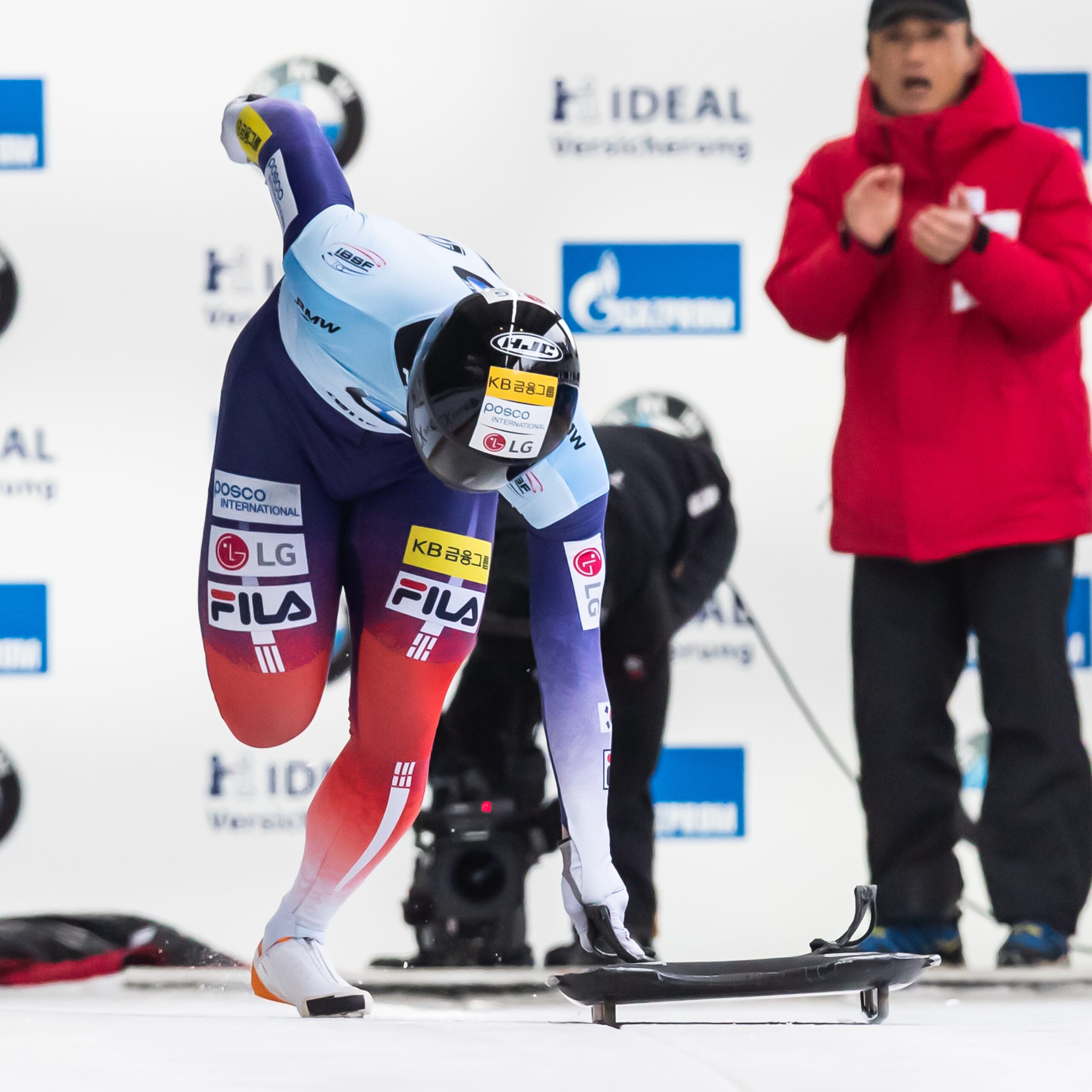
Brief Introduction of Jung Seunggi
Jung Seunggi is a distinguished skeleton racer from South Korea who has rapidly emerged as a prominent figure in the world of winter sports. Renowned for his resilience and dedication, Jung has competed at the highest levels of the sport, including multiple Olympic Winter Games and World Championships. He is widely regarded as the successor to the legendary Korean skeleton slider Yun Sung-bin, carrying the nation’s hopes on the ice track. Jung’s career is not only marked by impressive victories and medals but also by a remarkable story of overcoming a career-threatening injury. His journey is a testament to his unwavering spirit and his significant role in continuing South Korea’s legacy of excellence in skeleton racing, a sport that requires immense courage and precision as athletes hurtle headfirst down a frozen track at breathtaking speeds.

Jung Seunggi Overview
| Full Name | Jung Seunggi (정승기) |
| Date of Birth | March 17, 1999 |
| Age(as of 2025) | 26 |
| Birthplace | Paju, Gyeonggi Province, South Korea |
| Profession | Skeleton Racer |
| Husband/Wife | Not publicly available |
| Family | Information not disclosed |
| Relationship/Affairs(GF/BF) | Not publicly available |
| Net Worth | Information not disclosed |
Early Life and Education of Jung Seunggi
Jung Seunggi was born on March 17, 1999, in Paju, a city in the Gyeonggi Province of South Korea. His journey into the high-speed world of skeleton racing began in 2014 when he was just a third-year middle school student. Inspired after watching the skeleton events of the 2014 Sochi Winter Olympics on television, he was particularly moved by a commentator’s remark that anyone could excel in the sport, regardless of their prior athletic background. This sparked a profound motivation in the young Jung, who was a long jumper at the time. With a newfound dream of competing in the Olympics, he made the momentous decision to leave his hometown of Paju and move to Pyeongchang, the hub of South Korea’s sliding sports, to pursue his passion seriously. This early commitment was unusual, as many sliders in Korea begin the sport later in their high school years or as adults. He attended and graduated from Sangji Daegwallyeong High School before enrolling at Catholic Kwandong University. In 2023, he successfully earned a Bachelor’s degree in Sports Rehabilitation from the university, equipping himself with knowledge directly applicable to his demanding athletic career.
Jung Seunggi’s Career
Jung Seunggi’s career is a compelling narrative of prodigious talent, steady progression, and extraordinary resilience. He made his international debut in the 2014-2015 season, competing in the North American Cup. His early years were marked by consistent development, and he quickly established himself as a rising star. During the 2017-2018 season, while still a high school student, he won two gold medals in the North American Cup, a significant achievement for a young athlete competing against senior racers. His breakthrough continued in the 2018-2019 season when he dominated the Intercontinental Cup, securing the overall title.
A significant honor in his early career came during the 2018 PyeongChang Winter Olympics on home soil, where he was chosen as one of the promising young athletes to carry the Olympic Flag during the opening ceremony. This experience fueled his ambition to compete on the world’s biggest stage. He made his World Cup debut in the 2019-2020 season and his first World Championships appearance in 2019 in Whistler, where he secured an impressive ninth-place finish. He competed in his first Olympic Games at Beijing 2022, where he finished in 10th place, notably two positions ahead of his idol and mentor, Yun Sung-bin.
The 2022-2023 season was a landmark period for Jung. He captured a bronze medal at the IBSF World Championships in St. Moritz, the first for a Korean skeleton athlete since Yun’s in 2019. He also earned multiple medals on the World Cup circuit. The following season, he claimed his first-ever World Cup gold medal in La Plagne, France, in December 2023. However, his ascent was brutally halted in October 2024 when he suffered a catastrophic back injury during weight training. A ruptured disc led to nerve compression and symptoms of lower-body paralysis, requiring emergency surgery and casting serious doubt on his future, not just in the sport, but in his ability to walk again. Doctors warned of potential permanent disability.
Displaying incredible fortitude, Jung embarked on a grueling rehabilitation process. After eight months of intensive therapy, he made a miraculous return to the national team. Though the injury impacted his explosive start—once a signature strength—he refined his driving skills to maintain his competitive edge. His comeback was solidified with a bronze medal at a World Cup event in Lillehammer in late 2025. He went on to compete in the 2026 Milano-Cortina Winter Olympics, securing another top-10 finish, a remarkable achievement that cemented his status as a story of triumph over adversity.
Jung Seunggi Personal Life & Family
Information regarding Jung Seunggi’s personal life, including his relationships and details about his immediate family such as his father and any siblings, is not publicly available. He maintains a private life off the ice. However, it is known that his family has been a source of great support throughout his career. He has mentioned the difficulty of living away from his parents from a young age to pursue his skeleton training in Pyeongchang. In a 2026 interview, he expressed deep gratitude for his grandmother’s support, noting that she would stay up late to watch his competitions. One article from 2023 mentioned his mother’s name is Lee Gwi-soon and that she works as a department head at the Paju City Hall, where she was involved in a project related to the historic “Turtle Ship,” which later inspired his helmet design. According to public records, his personality type is INFJ (Advocate), characterized by being quiet and idealistic yet inspiring.

Awards and Achievements of Jung Seunggi
- 2023 IBSF World Championships: Bronze Medal (St. Moritz)
- 2023-2024 IBSF World Cup: Gold Medal (La Plagne)
- 2022-2023 IBSF World Cup: Overall 4th Place, Multiple Silver and Bronze Medals
- 2021-2022 IBSF World Cup: Bronze Medal (Sigulda)
- 2018-2019 IBSF Intercontinental Cup: Overall Champion
- 2017-2018 IBSF North American Cup: Two Gold Medals
- 2022 Beijing Winter Olympics: 10th Place
- 2026 Milano-Cortina Winter Olympics: 10th Place
- 2016 Winter Youth Olympics: 8th Place
Jung Seunggi Net Worth and Income
Specific details about Jung Seunggi’s net worth and income are not publicly disclosed. As a professional athlete in an Olympic winter sport, his income is likely derived from a combination of prize money from competitions like the IBSF World Cup circuit, funding and stipends from the national sports federation and his club, Gangwon Provincial Office, and potentially personal sponsorships or endorsements. However, verifiable figures for his career earnings and overall net worth as of 2025 are not available.
Legacy and Influence
Jung Seunggi’s legacy is defined by both his athletic prowess and his inspirational resilience. He is considered the flag-bearer for the second generation of South Korean skeleton athletes, stepping into the formidable shoes of Olympic champion Yun Sung-bin. By consistently performing at a world-class level, winning World Championship and World Cup medals, he has ensured that South Korea remains a formidable force in international skeleton racing. His success provides a crucial bridge, inspiring younger athletes to take up the sport and demonstrating that the country’s success in sliding sports was not a singular event but the foundation of a lasting program.
Beyond his results, his comeback from a paralyzing back injury in 2024 has become a powerful narrative of the human spirit. Overcoming a prognosis that suggested a potential end to his career and normal mobility, his return to elite competition and a top-10 Olympic finish is a profound source of inspiration. Furthermore, his choice to feature a “Geobukseon” (Turtle Ship) on his helmet is a significant cultural statement. A self-professed Korean history enthusiast, he uses the helmet to express national pride and channel the fearless spirit of the legendary Admiral Yi Sun-sin’s warship, showcasing Korean heritage on a global stage.
Interesting Facts about Jung Seunggi
- He is an avid Korean history enthusiast and chose to feature the historic “Turtle Ship” (Geobukseon) on his helmet to symbolize a fearless, powerful approach on the track.
- His journey into skeleton was sparked by watching the 2014 Sochi Olympics on TV as a 16-year-old.
- In 2018, before he competed in the Olympics, he was selected as a flag bearer for the Olympic Flag at the PyeongChang Winter Games Opening Ceremony as a promising youth athlete.
- His Myers-Briggs Type Indicator (MBTI) personality type is reportedly INFJ, also known as the “Advocate.”
- Compared to his predecessor Yun Sung-bin who had a meteoric rise, Jung’s career has been characterized by a steadier, more gradual development, leading some to initially underestimate his potential.
Controversies
There are no publicly documented controversies involving Jung Seunggi. His career and public image have been consistently positive, focusing on his athletic achievements and inspirational journey.
Social Media Presence
- Instagram – He is known to have an Instagram account, but follower counts are not publicly available.
- Twitter – Information not disclosed.
- YouTube – Information not disclosed.
Final Words about Jung Seunggi
Jung Seunggi’s story continues to unfold as one of the most compelling in winter sports. Having firmly established himself as a world-class skeleton athlete, his focus remains on pushing the boundaries of his performance. His journey through a devastating injury has not only tested his physical limits but has also forged an even stronger mental resolve. As a two-time Olympian with a World Championship medal to his name, he has already built a formidable career. Looking ahead, his future plans undoubtedly include challenging for the top of the podium at future World Championships and the next Olympic Winter Games. Jung Seunggi’s biography is not just about race times and rankings; it is about the heart of a champion who has faced down adversity and emerged stronger, carrying the legacy of Korean skeleton racing with pride and unwavering determination.
 Team Dailly WikiBio