
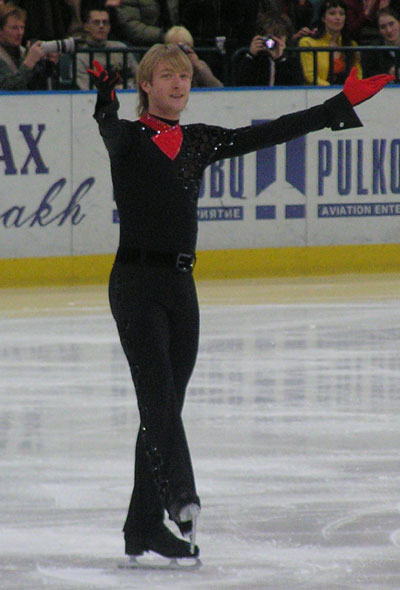
Brief Introduction of Jevgeni Plushenko
Jevgeni Viktorovich Plushenko is a renowned Russian former figure skater, widely regarded as one of the greatest in the history of the sport. His illustrious career is marked by incredible technical skill, artistic expression, and remarkable longevity. Plushenko is a four-time Olympic medalist, securing two individual medals (gold in 2006, silver in 2002 and 2010) and a team gold in 2014. He is also a three-time World champion and a seven-time European champion. Famous for his powerful jumps and innovative combinations, he consistently pushed the boundaries of men’s figure skating, leaving an indelible mark on the sport. After retiring from competitive skating, he transitioned into coaching, founding his own academy to mentor the next generation of skaters.
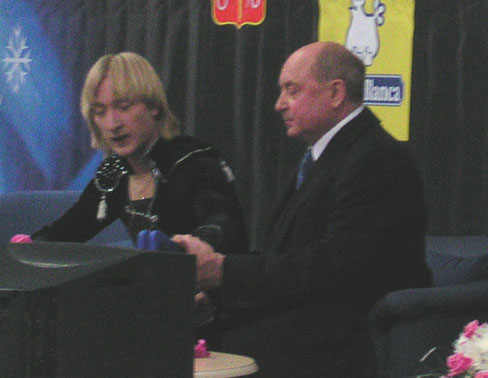
Jevgeni Plushenko Overview
| Full Name | Evgeni Viktorovich Plushenko |
| Date of Birth | November 3, 1982 |
| Age | 43 |
| Birthplace | Dzhamku, Solnechny District, Khabarovsk Krai, Russian SFSR, Soviet Union |
| Nationality | Russian |
| Profession | Former Figure Skater, Coach |
| Famous For | Four Olympic medals, three World titles, and seven European titles in figure skating |
| Education | Lesgaft National State University of Physical Education, Sport and Health; Saint Petersburg State University of Engineering and Economics (Faculty of tourism and hospitality) |
| Marital Status | Married |
| Spouse / Partner | Yana Rudkovskaya (m. 2009) |
| Children | Egor Evgenievich Plushenko, Alexander Evgenievich Plushenko, Arseniy Evgenievich Plushenko |
| Net Worth | Estimated between $10 million and $21 million |
Early Life and Education of Jevgeni Plushenko
Jevgeni Plushenko was born on November 3, 1982, in Dzhamku, a small settlement in the Khabarovsk Krai region of the Soviet Union. His father, Viktor, was a carpenter, and his mother, Tatiana, moved with the family to Volgograd when Jevgeni was young. He has an older sister. Plushenko was often sick as a child, and his mother believed that exercise would improve his health, enrolling him in figure skating lessons at the age of four. He showed immediate promise. When he was 11, the ice rink in Volgograd closed down. Recognizing his immense talent, his mother took him to Saint Petersburg to train with the acclaimed coach Alexei Mishin, a move that proved pivotal for his career. Initially, he moved alone, with his parents following later. He graduated from school No. 91 in Petrogradsky District in 1998. Plushenko pursued higher education, beginning his studies at the Lesgaft University in 2000 and graduating in 2005. He also studied at the Faculty of tourism and hospitality of the Saint Petersburg State University of Engineering and Economics, starting in 2004.
Jevgeni Plushenko Career
Early Career
Under the tutelage of Alexei Mishin, Plushenko’s career blossomed. He made rapid progress on the international junior circuit. At just 14 years old, he became the youngest-ever World Junior Champion in 1997. The following year, at age 15, he made a sensational senior debut by winning the bronze medal at the 1998 World Championships. During this period, a notable rivalry began to form with fellow Russian skater Alexei Yagudin, who also trained under Mishin until 1998. This rivalry would become one of the most compelling in the history of the sport.
Breakthrough
Plushenko’s breakthrough on the senior stage was solidified in the 1999–2000 season when he won his first European Championship and his first Grand Prix Final title. His true ascendancy came in the 2000–01 season, where he was undefeated, capturing his first World Championship title and defending his European and Grand Prix Final crowns. This dominant season established him as a formidable force in men’s figure skating, known for his technical prowess, including powerful quadruple jumps and complex combinations, which were revolutionary at the time. He became the first skater to land a quadruple toe loop-triple toe loop-double loop combination in competition.
Major Achievements and Success
Jevgeni Plushenko’s career is decorated with numerous titles and records. He is a four-time Olympic medalist, winning silver at the 2002 Salt Lake City and 2010 Vancouver Games, gold at the 2006 Turin Olympics, and a gold medal in the inaugural team event at the 2014 Sochi Olympics. His four Olympic medals once tied the record for the most medals won by a male figure skater. He is a three-time World Champion (2001, 2003, 2004) and a seven-time European Champion (2000, 2001, 2003, 2005, 2006, 2010, 2012). Furthermore, he is a four-time Grand Prix Final champion and a ten-time Russian National champion. Plushenko was known for pushing the sport’s technical boundaries; he was the first male skater to perform the Biellmann spin in senior competition and the first to land several difficult jump combinations, including the 4T–3T–3Lo.
Recent Work / Current Status
After a career plagued by numerous injuries and surgeries, Plushenko officially announced his retirement from competitive skating in March 2017. He then transitioned into a coaching role, founding the “Angels of Plushenko” figure skating academy in April 2017. Through his academy, he mentors the next generation of Russian skaters, with some of his students competing at major international events. He remains a prominent and influential figure in the figure skating community, often appearing at events and continuing to develop high-level athletes. His goal is to become one of the world’s top coaches and guide his students to Olympic success.
Jevgeni Plushenko Awards and Achievements
- Olympic Games: Gold (2006 Singles, 2014 Team), Silver (2002 Singles, 2010 Singles)
- World Championships: Gold (2001, 2003, 2004), Silver (1999), Bronze (1998)
- European Championships: Gold (2000, 2001, 2003, 2005, 2006, 2010, 2012), Silver (1998, 1999, 2004)
- Grand Prix Final: Gold (1999–2000, 2000–01, 2002–03, 2004–05), Silver (2001–02, 2003–04), Bronze (1998–99)
- Russian Championships: Ten-time Gold medalist (1999–2002, 2004–2006, 2010, 2012–2013)
- World Junior Championships: Gold (1997)
Jevgeni Plushenko Personal Life & Family
Jevgeni Plushenko’s personal life has often been in the public eye. He was first married to Maria Ermak, a sociology student, from 2005 to 2008. From this marriage, he has a son, Egor Evgenievich, born on June 15, 2006. In 2009, Plushenko married Yana Rudkovskaya, a prominent Russian music producer and media personality. Together, they have two sons: Alexander (often called “Sasha” or “Gnom Gnomych”), born in January 2013, and Arseniy, born in September 2020 via a surrogate mother. Alexander is also a figure skater and frequently performs in his father’s ice shows. Plushenko also briefly entered politics, being elected to the Legislative Assembly of Saint Petersburg in 2007 as a member of the A Just Russia party, though he later stepped away to focus on his skating career.

Jevgeni Plushenko Relationship Details
Jevgeni Plushenko was first married to Maria Ermak. They wed on June 18, 2005, and officially divorced in February 2008. They have one son together, Egor. In August 2009, Plushenko announced his engagement to Yana Rudkovskaya, a well-known record producer for Russian singer Dima Bilan. They were married on September 12, 2009. Rudkovskaya is also Plushenko’s manager and has been instrumental in promoting the “Plushenko brand.” The couple has two sons, Alexander and Arseniy. Their relationship is frequently featured in Russian media.
Jevgeni Plushenko Net Worth and Income
Jevgeni Plushenko has an estimated net worth of between $10 million and $21 million. His wealth is derived from a combination of his successful competitive career, lucrative endorsement deals with major brands, and prize money from competitions. After retiring, his income sources have diversified. He earns significantly from his coaching activities at the Angels of Plushenko academy, his popular ice shows, and various television and public appearances. His marriage to Yana Rudkovskaya, a successful producer, has also contributed to their family’s financial standing.
Jevgeni Plushenko Physical Appearance
- Height: 1.80 m (5 ft 11 in)
- Weight: Information not publicly available
- Eye Color: Information not publicly available
- Hair Color: Blonde
Jevgeni Plushenko Controversies
Plushenko’s career has not been without controversy. One of the most significant was the judging at the 2010 Vancouver Olympics, where he lost the gold medal to American Evan Lysacek. Plushenko landed a quadruple jump combination while Lysacek did not attempt one, leading to a debate over the value of technical difficulty versus artistry in the scoring system. Plushenko publicly voiced his disagreement with the result, stating, “Without quadruples… it’s not men’s figure skating.” Another controversy arose during the 2014 Sochi Olympics. After helping Russia win the team gold, he withdrew from the men’s individual event just moments before his short program, citing a back injury. His late withdrawal meant Russia had no replacement skater in the men’s competition, drawing some criticism. His selection for the Olympic team itself was also debated, as he was chosen over younger skaters who had performed better at the Russian nationals, following a private test skate.
Jevgeni Plushenko Social Media Presence
- Instagram – @plushenkoofficial
- Twitter – @EvgeniPlushenko
- YouTube – Information not disclosed
Interesting Facts about Jevgeni Plushenko
- He was the first male skater to perform the Biellmann spin, a move more commonly executed by female skaters, in senior competition.
- Throughout his career, he landed approximately 100 quadruple jumps in competitions.
- Under the old 6.0 scoring system, he received 75 perfect scores, and under the new system, he set 13 world records.
- Plushenko has undergone numerous surgeries throughout his career due to injuries, with reports of over 50,000 tiny bolts being inserted into his spine by 2014.
- In 2008, he performed on a miniature ice rink as part of Russian singer Dima Bilan’s winning Eurovision Song Contest performance.
Jevgeni Plushenko Legacy and Influence
Jevgeni Plushenko’s legacy in figure skating is immense and multifaceted. He is credited with revolutionizing the sport through his mastery of the quadruple jump and complex jump combinations, pushing the technical boundaries for male skaters. His combination of powerful athleticism and charismatic showmanship made him a dominant force for over a decade and a fan favorite worldwide. His longevity, competing at four Olympic Games and medaling in each one, is a testament to his resilience and dedication. Many contemporary skaters, including Nathan Chen, have cited Plushenko as a major inspiration. As a coach, he continues to shape the future of the sport by passing on his knowledge and experience to a new generation of Russian skaters at his academy.
Final Words about Jevgeni Plushenko
Jevgeni Plushenko’s journey from a frequently ill child in a small Soviet town to a global figure skating icon is a story of extraordinary talent and perseverance. For nearly two decades, he captivated audiences with his daring jumps, expressive performances, and an unyielding will to win. His trophy case, filled with Olympic, World, and European medals, only tells part of the story. Plushenko’s true impact lies in how he advanced the sport, setting new standards for technical excellence and inspiring countless others to follow. Despite facing numerous injuries and controversies, his passion for skating never waned. Today, as a coach, the “Tsar of the Ice” continues to contribute to the sport that he so thoroughly dominated, ensuring that the Jevgeni Plushenko biography continues to be written through the achievements of his students.
 Team Dailly WikiBio