
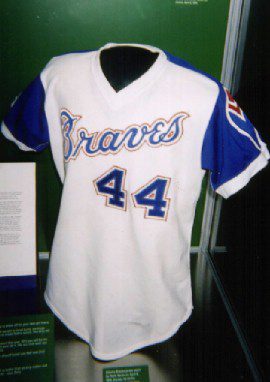
Brief Introduction of Hank Aaron
Henry Louis “Hank” Aaron, nicknamed “Hammerin’ Hank,” was a legendary American professional baseball right fielder who is widely regarded as one of the greatest baseball players of all time. His remarkable 23-season career in Major League Baseball (MLB) from 1954 to 1976 was defined by consistent excellence, culminating in his historic surpassing of Babe Ruth’s long-standing career home run record. Aaron’s journey from a childhood in the segregated South to becoming baseball’s home run king was marked by immense talent, unwavering perseverance, and quiet dignity. Beyond his on-field accomplishments, he was a trailblazer and a powerful advocate for civil rights, using his platform to challenge racial inequality. His impact on baseball and American society extends far beyond statistics, cementing his status as a true icon.

Hank Aaron Overview
| Full Name | Henry Louis Aaron |
| Date of Birth | February 5, 1934 |
| Age(as of 2025) | Would have been 91 |
| Birthplace | Mobile, Alabama, U.S. |
| Profession | Professional Baseball Player, Businessman |
| Husband/Wife | Barbara Lucas (m. 1953; div. 1971), Billye Suber Williams (m. 1973) |
| Family | Parents: Herbert Aaron Sr. and Estella (Pritchett) Aaron. Siblings: Seven, including brother Tommie Aaron, who also played in MLB. Children: Six children in total; Gary, Lary, Dorinda, Gaile, and Hank Jr. with Barbara Lucas, and Ceci with Billye Suber Williams. |
| Relationship/Affairs(GF/BF) | Not publicly available |
| Net Worth | Estimated at $25 million at the time of his death. |
Early Life and Education of Hank Aaron
Henry Louis Aaron was born on February 5, 1934, in Mobile, Alabama, to Herbert Aaron Sr. and Estella (Pritchett) Aaron. He was one of eight children and grew up in a poor family. His father worked as a shipyard riveter. His family could not afford baseball equipment, so he practiced by hitting bottle caps with sticks and created his own bats and balls from found materials. His boyhood idol was Jackie Robinson, who broke baseball’s color barrier. As a child, Aaron and his family moved to the Toulminville neighborhood. For his freshman and sophomore years, he attended Central High School, which was segregated and did not have an organized baseball team. He then transferred to the Josephine Allen Institute, a private school with an organized baseball program, for his junior year. His passion for baseball was evident from a young age, and he began playing for the Mobile Black Bears, a semipro team, while still a teenager. He briefly returned to school to finish his secondary education before his professional career took off.
Hank Aaron’s Career
Hank Aaron’s professional baseball journey began in 1951 when he signed with the Indianapolis Clowns of the Negro American League for $200 a month. He played with the Clowns for a few months, helping them win the 1952 Negro League World Series. His talent quickly drew the attention of MLB scouts, and in 1952, the Boston Braves purchased his contract for $10,000. Aaron was assigned to the Braves’ minor league affiliates, where he excelled. In 1953, playing for the Jacksonville Braves in the South Atlantic League, he was named the league’s Most Valuable Player after leading in multiple statistical categories. During this time, he was one of the first Black players in the league and faced significant racism.
Aaron made his Major League debut with the now Milwaukee Braves in 1954. He quickly established himself as a star. In 1956, he won his first of two National League batting titles with a .328 average. The following year, 1957, was arguably his best season; he won the NL Most Valuable Player (MVP) Award, leading the Braves to a World Series championship over the New York Yankees. He led the league in home runs and RBIs that year. Throughout his career, Aaron was a model of consistency and production. He was selected for a record 25 All-Star Games and won three Gold Glove Awards for his fielding. He is one of only two players to hit 30 or more home runs in a season at least fifteen times.
The most defining achievement of Aaron’s career was his pursuit and breaking of Babe Ruth’s all-time home run record of 714. This chase, which intensified in the early 1970s, thrust him into a national spotlight that was often harsh and filled with racial animosity. He received thousands of letters, many of which were hate mail and death threats against him and his family for daring to break the record of a white icon. Despite the immense pressure and threats, Aaron persevered. On April 8, 1974, in Atlanta, he hit his 715th career home run off Los Angeles Dodgers pitcher Al Downing, breaking the record in one of baseball’s most iconic moments. He would go on to hit 755 home runs in his career, a record that stood for 33 years until it was broken by Barry Bonds in 2007. After the 1974 season, Aaron was traded to the Milwaukee Brewers, where he played his final two seasons, retiring after the 1976 season. Aaron still holds the MLB records for the most career runs batted in (RBIs) (2,297), extra base hits (1,477), and total bases (6,856). He also ranks third all-time in hits (3,771). In 1982, his first year of eligibility, he was elected to the National Baseball Hall of Fame.
Hank Aaron Personal Life & Family
Hank Aaron’s personal life was shaped by his deep family roots and his experiences both on and off the baseball field. In 1953, he married Barbara Lucas. Together, they had five children: Gary, Lary, Dorinda, Gaile, and Hank Jr. One of their twin sons, born in 1957, passed away two days after birth. The pressures of his career and the constant racism he faced took a toll on his family life. He and Barbara divorced in 1971. On November 13, 1973, Aaron married Billye Suber Williams, with whom he had one child, Ceci. His brother, Tommie Aaron, also played in Major League Baseball, and together they hold the record for the most career home runs by a pair of siblings (768). Aaron was a Catholic, having converted with his family in 1959. Though widely known as “Hank,” he preferred to be called by his birth name, “Henry.” After his playing career, Aaron settled in the Atlanta area. He and his wife Billye were active philanthropists, co-founding the Hank Aaron Chasing the Dream Foundation to help children pursue their dreams. He passed away on January 22, 2021, at the age of 86 in Atlanta, Georgia.
Awards and Achievements of Hank Aaron
- 25-time All-Star (1955–1975)
- World Series champion (1957)
- National League (NL) Most Valuable Player (1957)
- 3-time Gold Glove Award winner (1958–1960)
- 2-time NL batting champion (1956, 1959)
- 4-time NL home run leader (1957, 1963, 1966, 1967)
- 4-time NL RBI leader (1957, 1960, 1963, 1966)
- Lou Gehrig Memorial Award (1970)
- Inducted into the National Baseball Hall of Fame (1982)
- Presidential Medal of Freedom (2002)
- Presidential Citizens Medal (2001)
- Thurgood Marshall Lifetime Achievement Award (2005)
- Major League Baseball All-Century Team (1999)
- Japanese Order of the Rising Sun, Gold Rays with Rosette (2016)
Hank Aaron Net Worth and Income
At the time of his death in January 2021, Hank Aaron’s net worth was estimated to be $25 million. While his MLB salary peaked at $240,000 per year in his final two seasons (equivalent to about $1.2 million today), his wealth was significantly bolstered by savvy business ventures and endorsements after his playing career. He famously had a significant endorsement deal with Coca-Cola. A successful businessman, Aaron owned a series of car dealerships in Georgia, selling brands like BMW, Land Rover, Toyota, and Honda. He also had numerous fast-food franchises under his 755 Restaurant Corporation. Following his retirement as a player, Aaron transitioned into a front-office role with the Atlanta Braves as an executive vice president, making him one of the first African Americans in senior MLB management. A dedicated philanthropist, he gave away a substantial portion of his endorsement earnings and established the Hank Aaron Chasing the Dream Foundation.
Legacy and Influence
Hank Aaron’s legacy transcends his remarkable baseball statistics; he is remembered as a pivotal figure in the advancement of civil rights and a role model for his quiet dignity in the face of immense adversity. By breaking Babe Ruth’s home run record, he shattered a significant cultural barrier, enduring racist threats and hate mail with grace and determination. This experience fueled his lifelong activism. After retiring, he became a vocal advocate for minority hiring in baseball and was one of the first Black individuals to hold a senior management position in an MLB front office. He actively worked with organizations like the NAACP to promote racial justice and create opportunities for Black athletes. In 1999, MLB introduced the Hank Aaron Award to honor the best offensive player in each league annually. His courage and perseverance opened doors for future generations of players and continue to inspire people fighting for equality. As congressman Andrew Young stated, “Through his long career, Hank Aaron has been a model of humility, dignity, and quiet competence.”
Interesting Facts about Hank Aaron
- If you removed all 755 of his home runs, Hank Aaron would still have over 3,000 career hits.
- He and his brother, Tommie, hold the record for the most career home runs by a pair of siblings with 768.
- His childhood hero was Jackie Robinson, and a speech by Robinson inspired Aaron to pursue his baseball career.
- In the summer of 1973, while chasing the home run record, he received so many letters that the Braves had to hire a secretary to help him sort through them.
- By his final season, he was the last former Negro league player on a major league roster.
- Boxing legend Muhammad Ali once called Aaron, “The only man I idolize more than myself.”
- For a portion of his early career, he batted cross-handed (with his left hand above his right as a right-handed hitter).
Controversies
The primary controversy surrounding Hank Aaron’s career was not of his own making but rather the vitriolic, racist backlash he faced while pursuing Babe Ruth’s home run record. The chase was marred by an onslaught of hate mail, death threats against him, and even a plot to kidnap his daughter. This racist reaction from a segment of the public highlighted the deep racial tensions in the country. Another minor controversy occurred at the start of the 1974 season when Braves management wanted to bench Aaron for the opening series in Cincinnati to ensure he would break the record at home in Atlanta. However, Baseball Commissioner Bowie Kuhn ruled that he had to play in two of the three games. Years later, when Barry Bonds broke his home run record, Aaron was not in attendance, leading to speculation about his feelings towards Bonds, who faced accusations of using performance-enhancing drugs. Aaron did, however, offer a pre-recorded congratulatory message that was played in the stadium.
Social Media Presence
As a historical figure who was most active long before the advent of social media and who passed away in 2021, Hank Aaron did not have personal, active social media accounts. His legacy is maintained by organizations such as the Baseball Hall of Fame, the Atlanta Braves, and various sports media outlets on their platforms.
- Instagram – Not applicable
- Twitter – Not applicable
- YouTube – Not applicable
Final Words about Hank Aaron
Hank Aaron’s life and career represent a monumental American story of talent, perseverance, and grace under pressure. He retired as one of the most accomplished players in baseball history, holding records for home runs, RBIs, total bases, and extra-base hits that underscored his incredible consistency and power. His greatest triumph, however, was arguably not just breaking the home run record, but doing so while confronting a torrent of racist hatred with unwavering dignity. After his playing days, he seamlessly transitioned into a respected businessman and a pioneering baseball executive, continuing to advocate for racial equality within the sport and beyond. His work through the Chasing the Dream Foundation continues to support underprivileged youth. Hank Aaron’s legacy is not just that of a home run king, but of a courageous civil rights advocate and a humanitarian whose impact will be felt for generations to come.
 Team Dailly WikiBio