Brief Introduction of Elizabeth Holmes
Elizabeth Anne Holmes is an American former biotechnology entrepreneur who was the founder and CEO of Theranos, a now-defunct health technology company. Holmes claimed that Theranos had devised blood tests that required very small amounts of blood and could be performed rapidly using small, automated devices the company had developed. These claims were later proven to be false. At its peak in 2014, Theranos was valued at $9 billion, making Holmes, on paper, the youngest self-made female billionaire in the world. However, a series of journalistic and regulatory investigations revealed the fraudulent nature of Theranos’s claims, leading to the company’s collapse. In 2022, Holmes was convicted of defrauding investors and sentenced to over 11 years in federal prison.

Elizabeth Holmes Overview
| Full Name | Elizabeth Anne Holmes |
| Date of Birth | February 3, 1984 |
| Age(as of 2025) | 41 |
| Birthplace | Washington, D.C., U.S. |
| Profession | Former Businesswoman, Convicted Fraudster |
| Husband/Wife | William “Billy” Evans |
| Family | Father: Christian Rasmus Holmes IV, Mother: Noel Anne Holmes (née Daoust) |
| Relationship/Affairs(GF/BF) | Ramesh “Sunny” Balwani (former) |
| Net Worth | Estimated to be negative $226 million (as of June 2025) |
Early Life and Education of Elizabeth Holmes
Elizabeth Anne Holmes was born on February 3, 1984, in Washington, D.C., to Noel Anne, a Congressional committee staffer, and Christian Rasmus Holmes IV, who held various governmental roles, including a position at USAID. Her family has a notable lineage, with ancestors like Charles Louis Fleischmann, the founder of Fleischmann’s Yeast. The family moved to Houston, Texas, during her youth. From an early age, Holmes displayed a strong ambition; at nine years old, she wrote a letter to her father stating her desire to “discover something new, something that mankind didn’t know was possible to do.” During high school at St. John’s School in Houston, she developed an interest in computer programming and even started a small business selling C++ compilers to Chinese universities. Her interest in Mandarin led her to attend Stanford University’s summer program. In 2002, Holmes enrolled at Stanford University to study chemical engineering. She was named a President’s Scholar, which came with a stipend for a research project. As a freshman, she worked in the lab of Channing Robertson, a distinguished professor who would later become one of the first board members of Theranos. The summer after her freshman year, she interned at the Genome Institute of Singapore, working on developing methods to detect SARS-CoV-1. This experience, coupled with her reported fear of needles, solidified her idea for a less invasive form of blood testing. In 2003, she filed her first patent for a wearable drug-delivery patch. In March 2004, at the age of 19, Holmes dropped out of Stanford’s School of Engineering to found the company that would become Theranos, using her tuition money as initial funding.
Elizabeth Holmes’s Career
Elizabeth Holmes founded Real-Time Cures in 2003, which she later renamed Theranos, a portmanteau of “therapy” and “diagnosis.” The company’s mission was to revolutionize the blood-testing industry by developing technology capable of running a multitude of tests from a single drop of blood obtained via a fingerprick. This vision attracted significant investment from high-profile individuals and venture capital firms, including Tim Draper and Oracle founder Larry Ellison. Over the next decade, Theranos raised over $700 million, reaching a valuation of $9 billion by 2014. This made Holmes, who owned half of the company’s stock, the world’s youngest self-made female billionaire with a net worth of $4.5 billion. Holmes became a media sensation, frequently compared to Steve Jobs for her signature black turtleneck, deep voice, and ambitious vision. She graced the covers of major magazines like Forbes and Fortune and established partnerships with companies like Walgreens to bring Theranos’s testing centers to the public. However, the company operated in extreme secrecy, a tactic Holmes defended as necessary to protect its proprietary technology. In 2015, the facade began to crumble when a series of investigative articles by The Wall Street Journal raised serious questions about the accuracy and reliability of Theranos’s technology. These reports revealed that the company was performing most of its tests on traditional, commercially available machines, not its much-hyped “Edison” device. The revelations triggered a cascade of regulatory investigations by the FDA, SEC, and Centers for Medicare & Medicaid Services. In 2018, the SEC charged Holmes and former Theranos president Ramesh “Sunny” Balwani with “massive fraud.” Holmes settled with the SEC, agreeing to a $500,000 fine, the return of 18.9 million shares, a relinquishment of her voting control, and a ten-year ban from serving as an officer or director of a public company. Theranos officially dissolved in September 2018.
Elizabeth Holmes Personal Life & Family
Elizabeth Holmes’s personal life has been a subject of public interest, particularly her relationships. For much of Theranos’s existence, she was in a secret romantic relationship with Ramesh “Sunny” Balwani, who was nearly two decades her senior and served as the company’s president and COO. They met in 2002 during a trip to Beijing through a Stanford program when Holmes was 18. Their relationship, which they concealed from investors and employees, ended around the time Balwani left Theranos in 2016. During her trial, Holmes accused Balwani of controlling and abusive behavior, claims he has denied. After her relationship with Balwani ended, Holmes began dating William “Billy” Evans in 2017. Evans is the heir to the Evans Hotels group based in San Diego. The couple reportedly married in a private ceremony in 2019. They have two children together. Their son, William, was born in July 2021, which delayed the start of her criminal trial. Their daughter, Invicta, was born in early 2023, shortly before Holmes was scheduled to begin her prison sentence. Her family, including her parents and Evans, have been supportive presences throughout her legal battles.
Awards and Achievements of Elizabeth Holmes
Before her downfall, Elizabeth Holmes received numerous accolades for her perceived innovation and success with Theranos. Many of these have since been a source of controversy, and while some organizations have not formally rescinded them, they stand in stark contrast to her later conviction.
- Named one of Time magazine’s “100 Most Influential People” in 2015.
- Received an Honorary Doctor of Humane Letters from Pepperdine University in 2015.
- Awarded the 2015 Horatio Alger Award, becoming its youngest ever recipient.
- Received the Forbes “Under 30 Doers Award” in 2015.
- Appointed a member of the Harvard Medical School Board of Fellows in 2015.
Elizabeth Holmes Net Worth and Income
At the height of Theranos’s success in 2015, Forbes estimated Elizabeth Holmes’s net worth to be $4.5 billion, based on her 50% stake in the $9 billion company. This made her the youngest self-made female billionaire in the United States at the time. However, this wealth was entirely tied to her shares in the privately held company and was not liquid. Following the revelations of fraud, Forbes revised its estimate of her net worth to zero in June 2016, reasoning that her common stock would be worthless after paying back investors with preferred shares. As of June 2025, her net worth is estimated to be negative $226 million. This figure is a direct result of the court-ordered restitution she and Sunny Balwani must pay to their victims, which totals $452 million. Holmes is responsible for half of this amount. While incarcerated, her income is minimal, earning between approximately 23 cents and $1.15 per hour from her prison job.

Legacy and Influence
Elizabeth Holmes’s legacy is a complex and cautionary tale in Silicon Valley and the broader business world. Initially, she was hailed as a visionary, a female pioneer in the male-dominated tech industry who was poised to democratize healthcare. She inspired many with her story of a young college dropout changing the world. However, her story is now more commonly cited as a stark example of the dangers of “fake it ’til you make it” culture, unchecked ambition, and corporate fraud. The Theranos scandal exposed significant flaws in the venture capital ecosystem, where charisma and a compelling narrative can sometimes overshadow the need for rigorous due diligence. The saga has had a lasting impact on how investors, journalists, and the public scrutinize startup claims, particularly in the health-tech sector. Her story has been extensively documented in the book “Bad Blood: Secrets and Lies in a Silicon Valley Startup” by John Carreyrou, an HBO documentary “The Inventor: Out for Blood in Silicon Valley,” and the Hulu miniseries “The Dropout,” cementing her place in popular culture as a symbol of corporate deceit.
Interesting Facts about Elizabeth Holmes
- As a child, she was an avid reader and could reportedly quote Jane Austen by heart.
- She adopted a vegan diet and was known for drinking a daily concoction of pulverized vegetables, including cucumber, parsley, kale, and spinach.
- Holmes intentionally lowered the pitch of her voice, believing it would help her be taken more seriously in the business world.
- During high school, she learned Mandarin and sold C++ compilers to Chinese universities.
- She holds dozens of U.S. and international patents in her name, the first of which was filed while she was still at Stanford.
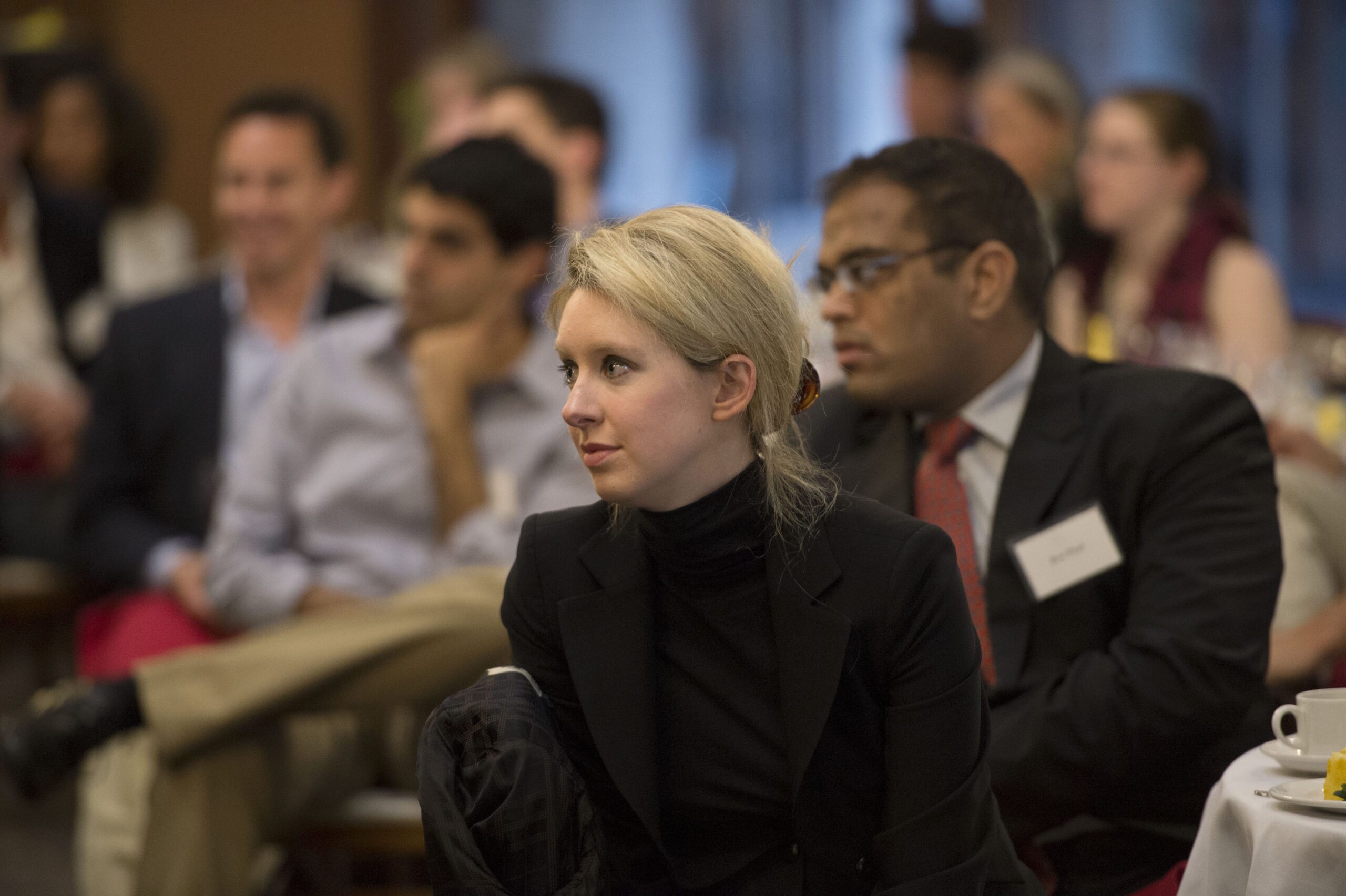
- She famously wore a uniform of a black turtleneck, which drew frequent comparisons to Apple co-founder Steve Jobs.
Controversies
The primary controversy surrounding Elizabeth Holmes is the massive fraud she perpetrated through her company, Theranos. Beginning in late 2015, investigations revealed that Theranos’s proprietary blood-testing technology was a failure, and the company was using conventional machines from other manufacturers to run most of its tests, all while misleading investors, doctors, and patients about its capabilities. In June 2018, a federal grand jury indicted Holmes and her former partner, Ramesh “Sunny” Balwani, on multiple counts of wire fraud and conspiracy to commit wire fraud. Her trial, which was delayed by the COVID-19 pandemic and her pregnancy, began in August 2021. On January 3, 2022, a jury found Holmes guilty on four counts of defrauding investors: three counts of wire fraud and one count of conspiracy to commit wire fraud. She was found not guilty on four counts related to defrauding patients. On November 18, 2022, she was sentenced to 11.25 years (135 months) in federal prison. She and Balwani were also ordered to pay $452 million in restitution to their victims.
Social Media Presence
- Instagram – Not publicly available
- Twitter – Not publicly available
- YouTube – Not publicly available
Final Words about Elizabeth Holmes
Elizabeth Holmes is currently serving her prison sentence at the Federal Prison Camp in Bryan, Texas. She reported to the minimum-security facility on May 30, 2023. Her sentence, originally over 11 years, has been slightly reduced, with a current projected release date in 2032. Her story serves as a definitive cautionary tale about the intersection of ambition, hubris, and deception in the high-stakes world of Silicon Valley startups. Once celebrated as a revolutionary entrepreneur and the world’s youngest self-made female billionaire, her name is now synonymous with one of the most significant corporate fraud cases of the 21st century. The fall of Theranos and the conviction of its founder have left an indelible mark on the tech and healthcare industries, prompting greater skepticism and a push for more stringent oversight of ambitious claims made by startups. While she serves her time, the narrative of her dramatic rise and fall continues to fascinate the public and serve as a powerful lesson on ethics and accountability in innovation.