
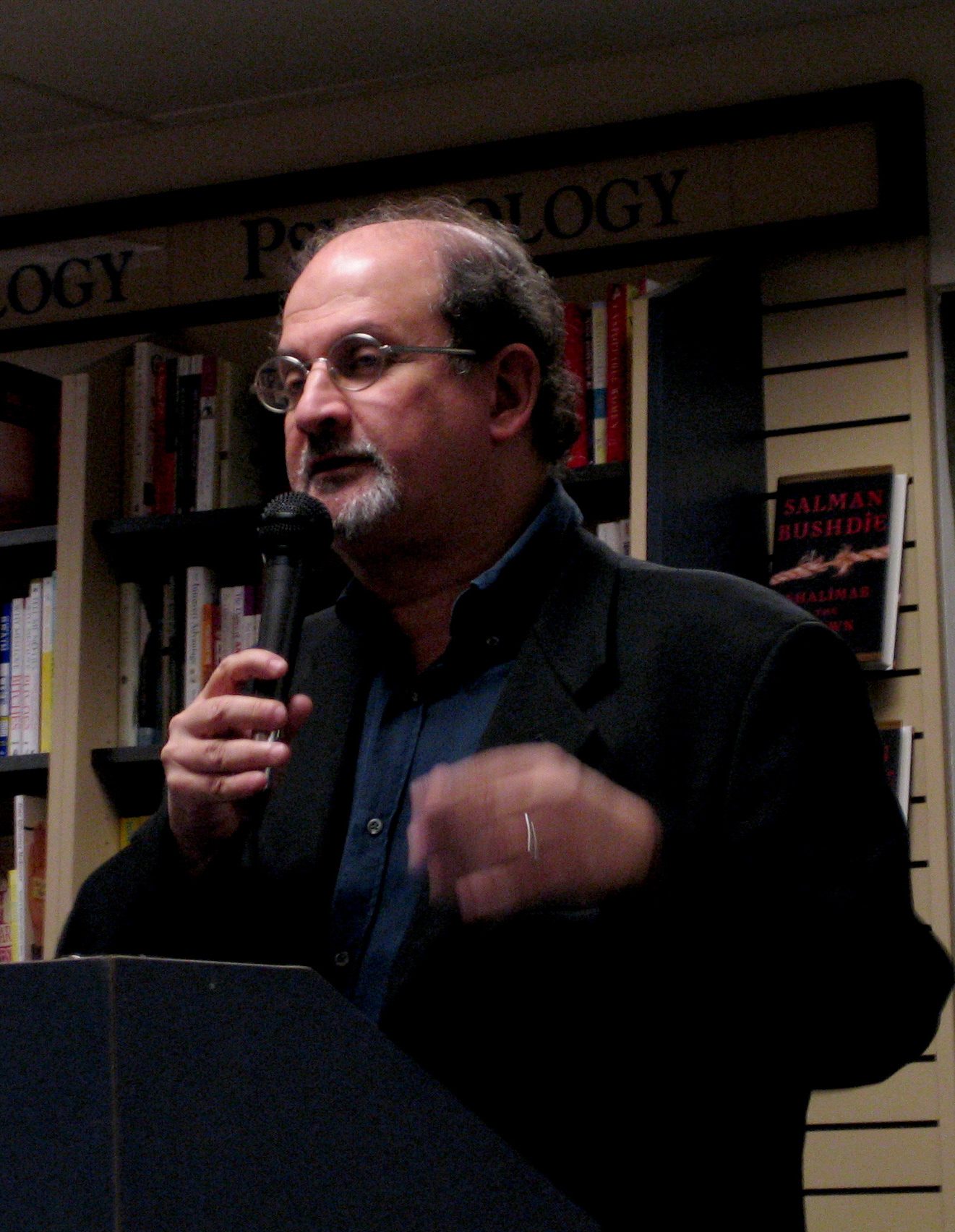
Brief Introduction of Salman Rushdie
Sir Ahmed Salman Rushdie is a celebrated Indian-born British-American novelist and essayist, renowned for his provocative and insightful works that masterfully blend magical realism with historical fiction. His narratives often explore the complex interplay between Eastern and Western civilizations, delving into themes of migration, identity, and the postcolonial experience. Rushdie’s profound impact on contemporary literature was firmly established with his second novel, “Midnight’s Children,” which won the prestigious Booker Prize in 1981. However, he garnered global attention of a different nature with his fourth novel, “The Satanic Verses,” which sparked a major controversy in the Muslim world, leading to a fatwa calling for his death issued by Iran’s Ayatollah Khomeini in 1989. This event transformed Rushdie into a symbol of free expression and artistic freedom, a role he has continued to embrace throughout his career. Despite the threats to his life, he has remained a prolific and influential voice in world literature.

Salman Rushdie Overview
| Full Name | Sir Ahmed Salman Rushdie |
| Date of Birth | June 19, 1947 |
| Age(as of 2025) | 78 |
| Birthplace | Bombay (now Mumbai), British India |
| Profession | Novelist, Essayist |
| Husband/Wife | Rachel Eliza Griffiths (m. 2021), Padma Lakshmi (m. 2004; div. 2007), Elizabeth West (m. 1997; div. 2004), Marianne Wiggins (m. 1988; div. 1993), Clarissa Luard (m. 1976; div. 1987) |
| Family | Son of Anis Ahmed Rushdie (father) and Negin Bhatt (mother). He has three sisters. He has two sons, Zafar and Milan. |
| Relationship/Affairs(GF/BF) | Information not publicly available in detail beyond his marriages. |
| Net Worth | Estimated between $10 million and $15 million. |
Early Life and Education of Salman Rushdie
Sir Ahmed Salman Rushdie was born on June 19, 1947, in Bombay (now Mumbai), India, into a Kashmiri Muslim family. His father, Anis Ahmed Rushdie, was a Cambridge-educated lawyer who became a businessman, and his mother, Negin Bhatt, was a teacher. Rushdie was the only son among four children. He grew up in a prosperous and cultured environment and received his early education at the Cathedral and John Connon School in Bombay. At the age of fourteen, he was sent to England to attend the prestigious Rugby School in Warwickshire. This move marked the beginning of his lifelong engagement with the themes of migration and cultural hybridity that would become central to his literary work. In 1964, his family moved to Karachi, Pakistan, though Rushdie remained in England to continue his education. He went on to study history at King’s College, Cambridge, where he earned a Master of Arts degree in 1968. During his time at Cambridge, he was involved with the famous Footlights theatre company, an early indication of his creative inclinations.
Salman Rushdie’s Career
After graduating from Cambridge, Salman Rushdie worked for a time in Pakistani television before returning to England. For much of the 1970s, he worked as an advertising copywriter for the agencies Ogilvy & Mather and Charles Barker. It was during this period that he wrote his first novel, “Grimus,” published in 1975. This science fiction fantasy was largely overlooked by critics and the public. Rushdie’s literary breakthrough came with his second novel, “Midnight’s Children,” in 1981. This sprawling, allegorical novel about the history of modern India was a critical and commercial success, winning the prestigious Booker Prize in 1981. It was later awarded the “Booker of Bookers” in 1993 and the “Best of the Booker” in 2008, solidifying its place as a landmark of postcolonial literature. His next novel, “Shame” (1983), explored the political turmoil in Pakistan and was also shortlisted for the Booker Prize. In 1988, Rushdie published his most controversial work, “The Satanic Verses.” The novel, which draws on Islamic tradition, was deemed blasphemous by many Muslims, leading to worldwide protests and book burnings. In 1989, Iran’s Supreme Leader, Ayatollah Ruhollah Khomeini, issued a fatwa, or religious edict, calling for Rushdie’s death. This forced Rushdie into hiding for nearly a decade under the protection of the British government. Despite the immense personal danger, Rushdie continued to write prolifically. During his time in hiding, he published the children’s book “Haroun and the Sea of Stories” (1990) and the novel “The Moor’s Last Sigh” (1995). He has since published numerous other acclaimed novels, including “The Ground Beneath Her Feet” (1999), “Shalimar the Clown” (2005), and “Quichotte” (2019), which was also shortlisted for the Booker Prize. His memoir, “Joseph Anton” (2012), recounts his experience living under the fatwa. Most recently, he published “Victory City” in 2023 and a memoir about the 2022 stabbing attack on him, titled “Knife: Meditations After an Attempted Murder” in 2024.
Salman Rushdie Personal Life & Family
Salman Rushdie’s personal life has been as eventful as his literary career. He has been married five times. His first wife was Clarissa Luard, with whom he was married from 1976 to 1987. They have a son, Zafar. His second marriage was to the American novelist Marianne Wiggins from 1988 to 1993. His third wife was Elizabeth West, from 1997 to 2004, with whom he has a son named Milan. From 2004 to 2007, he was married to the Indian-American model, actress, and television host Padma Lakshmi. In 2021, Rushdie married the American poet and novelist Rachel Eliza Griffiths. Raised in a Muslim family, Rushdie has since identified as an atheist, though he maintains a deep interest in religion and its role in society. He has been a vocal advocate for freedom of speech and has held academic positions at various universities, including Emory University and New York University. Since 2000, he has lived in the United States and became a US citizen in 2016. In August 2022, Rushdie was attacked on stage at a literary event in Chautauqua, New York, and sustained severe injuries, including the loss of sight in one eye.
Awards and Achievements of Salman Rushdie
- Booker Prize for “Midnight’s Children” (1981)
- James Tait Black Memorial Prize for “Midnight’s Children” (1981)
- Prix du Meilleur Livre Étranger for “Shame”
- Whitbread Award for “The Satanic Verses” (1988)
- Booker of Bookers for “Midnight’s Children” (1993)
- Commandeur de l’Ordre des Arts et des Lettres (1999)
- Knighted by Queen Elizabeth II for his services to literature (2007)
- Best of the Booker for “Midnight’s Children” (2008)
- Golden PEN Award
- Hans Christian Andersen Literature Award (2014)
- Companion of Honour (2022)
- Lifetime Disturbing The Peace Award (2023)
Salman Rushdie Net Worth and Income
As of 2025, Salman Rushdie’s net worth is estimated to be between $10 million and $15 million. His wealth has been primarily accumulated through his long and successful career as an author. The main sources of his income include royalties from his numerous bestselling novels, which have been translated into over 40 languages. He also earns income from advances for new books, speaking engagements at literary festivals and universities, and academic fellowships. The film and stage adaptations of his works, such as “Midnight’s Children,” have also contributed to his earnings. While the fatwa issued against him in the 1990s impacted his ability to make public appearances and earn from them for a period, his literary reputation and continued prolific output have ensured a steady and significant income.

Legacy and Influence
Salman Rushdie’s legacy in world literature is profound and multifaceted. He is considered one of the most significant writers of the postcolonial era, and his work has had a transformative impact on the development of the English-language novel. His innovative use of magical realism, blended with historical events and political commentary, has inspired a generation of writers. Rushdie’s novels are celebrated for their linguistic exuberance, their complex narratives that weave together personal and national histories, and their bold exploration of themes such as identity, migration, and religious and cultural conflict. Beyond his literary contributions, Rushdie has become a global icon for freedom of expression. His courageous defiance in the face of the fatwa and his unwavering advocacy for the rights of writers and artists have made him a powerful symbol of intellectual bravery. His work is widely studied in academic institutions, and he remains a vital and influential voice in contemporary cultural and political discourse.
Interesting Facts about Salman Rushdie
- His father adopted the surname “Rushdie” in honor of the 12th-century Andalusian philosopher Averroes (Ibn Rushd).
- Before becoming a full-time writer, he worked as an advertising copywriter and is credited with creating the famous American Express slogan “That’ll do nicely.”
- His novel “Midnight’s Children” has been voted the best winner of the Booker Prize on two separate occasions, in 1993 and 2008, to mark the prize’s 25th and 40th anniversaries.
- During his years in hiding, he used the pseudonym Joseph Anton, which was a combination of the first names of two of his favorite writers, Joseph Conrad and Anton Chekhov.
- He has made cameo appearances in films, including “Bridget Jones’s Diary.”
- He wrote the children’s books “Haroun and the Sea of Stories” and “Luka and the Fire of Life” for his two sons, Zafar and Milan, respectively.
- He has been a vocal supporter of free speech and has served as the president of PEN America.
Controversies
The most significant controversy of Salman Rushdie’s career, and one that has defined much of his public life, is the “Satanic Verses affair.” Following the publication of his novel “The Satanic Verses” in 1988, many Muslims around the world considered it blasphemous for its fictionalized account of the life of the Prophet Muhammad. The book was banned in several countries, and its publication led to violent protests. The controversy escalated dramatically on February 14, 1989, when Ayatollah Ruhollah Khomeini, the Supreme Leader of Iran, issued a fatwa, or religious edict, calling for Rushdie’s execution. A bounty was placed on his head, and Rushdie was forced to go into hiding under the protection of the British government for almost a decade. The fatwa led to a severing of diplomatic relations between the UK and Iran and resulted in violence against those associated with the book’s publication, including the murder of its Japanese translator, Hitoshi Igarashi, and attacks on its Italian translator and Norwegian publisher. Although the Iranian government formally withdrew its support for the fatwa in 1998, it has never been officially rescinded and has been reaffirmed by some religious foundations in Iran. The threat against Rushdie’s life tragically materialized in August 2022 when he was stabbed multiple times on stage at an event in New York.
Social Media Presence
- Instagram – Not publicly available or active.
- Twitter – He has an active presence, though follower counts fluctuate.
- YouTube – No official channel.
Final Words about Salman Rushdie
Salman Rushdie remains one of the most important literary figures of our time. His work continues to challenge, provoke, and inspire readers around the world. Despite the decades-long threat to his life, which culminated in the near-fatal attack in 2022, Rushdie has refused to be silenced. His resilience and unwavering commitment to artistic freedom serve as a powerful testament to the enduring power of the written word. His recent works, including the novel “Victory City” and the memoir “Knife,” demonstrate that his creative energies remain undiminished. As both a master storyteller and a courageous advocate for free expression, Salman Rushdie’s legacy is not only etched in his brilliant body of work but also in his principled stand against intolerance and censorship. His life and career are a profound reminder of the vital role that literature plays in shaping our understanding of the world and our place within it.
 Team Dailly WikiBio