
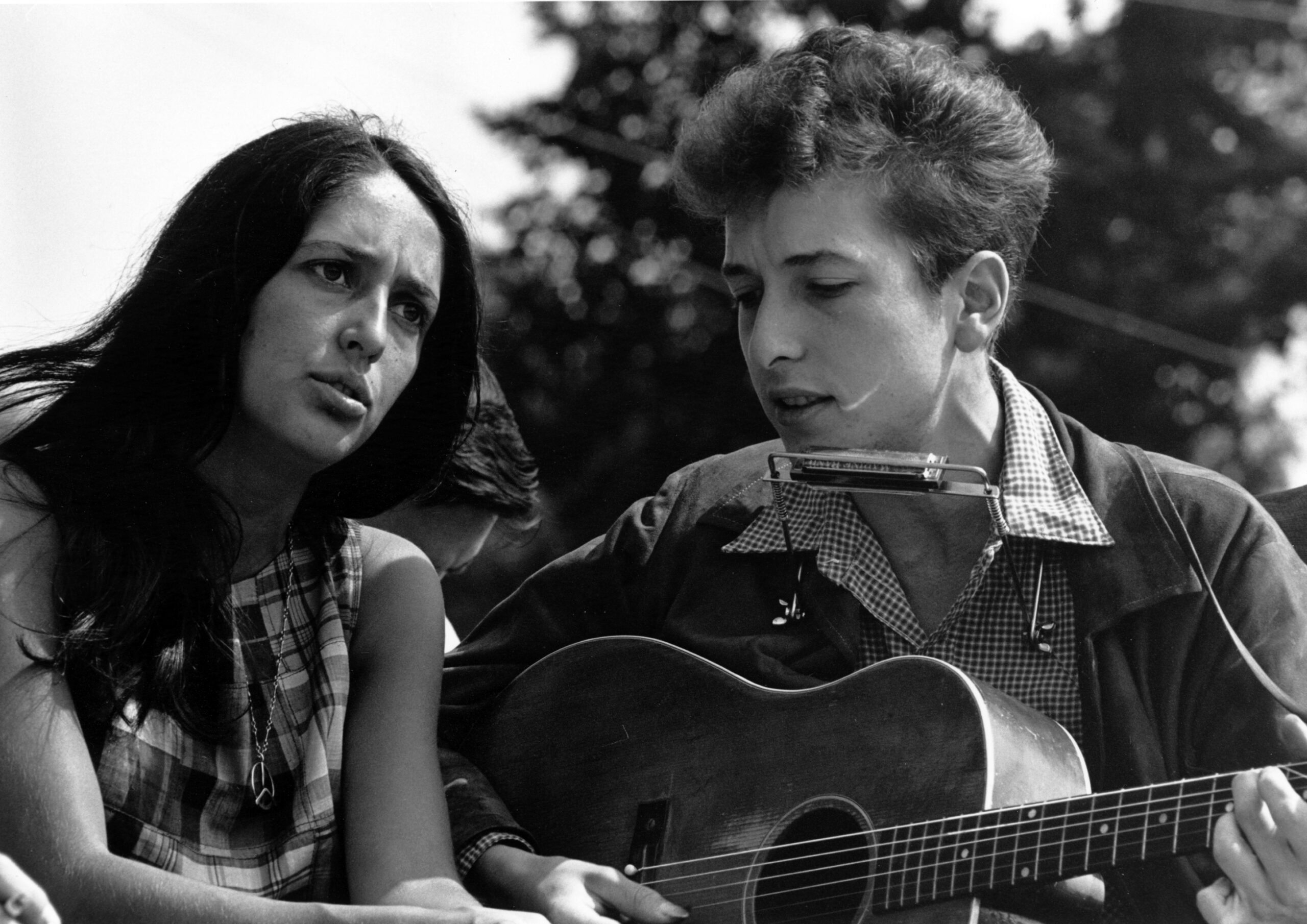
Brief Introduction of Joan Baez
Joan Baez is a legendary American singer, songwriter, musician, and activist whose career has spanned over six decades. Renowned for her highly influential role in the 1960s folk music revival, Baez’s crystalline soprano voice became synonymous with the era’s protest and social justice movements. Her music often carries themes of nonviolence, civil rights, and human rights, making her a leading voice for social change. Baez was instrumental in popularizing the songs of Bob Dylan and has interpreted the works of many other notable songwriters. Beyond her musical contributions, she is known for her unwavering activism, participating in marches with Martin Luther King Jr., co-founding the Institute for the Study of Nonviolence, and consistently using her platform to advocate for peace and equality. Her enduring legacy is that of a powerful artist who seamlessly blended her creative talents with a profound commitment to making the world a more just place.

Joan Baez Overview
| Full Name | Joan Chandos Baez |
| Date of Birth | January 9, 1941 |
| Age(as of 2025) | 84 |
| Birthplace | Staten Island, New York, U.S. |
| Profession | Singer, Songwriter, Musician, Activist |
| Husband/Wife | David Harris (m. 1968; div. 1973) |
| Family | Father: Albert Baez, Mother: Joan Bridge Baez, Son: Gabriel Harris, Sisters: Pauline Marden, Mimi Fariña |
| Relationship/Affairs(GF/BF) | Information not publicly available in detail, though her past relationship with Bob Dylan is well-documented. |
| Net Worth | Estimated $5 million to $11 million |
Early Life and Education of Joan Baez
Joan Chandos Baez was born on January 9, 1941, in Staten Island, New York. Her father, Albert Baez, was a prominent physicist born in Mexico, and her mother, Joan Bridge Baez, was born in Scotland. The family, which included Joan’s two sisters, Pauline and Mimi, converted to Quakerism during her early childhood. This upbringing deeply instilled in her the principles of pacifism and social justice that would define her life. Due to her father’s work with UNESCO, the family moved frequently, living in various locations across the United States and internationally, including England, France, Switzerland, and Iraq. Growing up, Baez experienced racial prejudice due to her Mexican heritage, which fueled her early commitment to civil rights. She graduated from Palo Alto High School in 1958. After graduation, her family moved to the Boston area, where her father joined the faculty at MIT. Baez briefly attended the drama school at Boston University but found it unfulfilling and soon dropped out to focus on the burgeoning folk music scene in Cambridge.
Joan Baez’s Career
Joan Baez’s professional career took flight after a standout performance at the 1959 Newport Folk Festival. Invited on stage by fellow folk singer Bob Gibson, her stunning soprano voice captivated the audience and critics alike, earning her the nickname “barefoot Madonna.” This breakthrough led to a contract with Vanguard Records, and she released her debut album, “Joan Baez,” in 1960. The album, a collection of traditional folk ballads, was an immediate success and, along with her subsequent albums “Joan Baez, Vol. 2” and “Joan Baez in Concert,” achieved gold record status. Throughout the early 1960s, she became a leading figure in the American folk music revival. She was instrumental in the career of a then-unknown Bob Dylan, recording his songs and inviting him on stage during her concerts, which greatly expanded his audience. Their romantic relationship and musical partnership became legendary. Baez was a fixture at major civil rights and anti-war demonstrations. Her performance of “We Shall Overcome” at the 1963 March on Washington cemented her status as a voice of the movement. By the late 1960s and into the 1970s, Baez began writing her own material. Her 1971 cover of The Band’s “The Night They Drove Old Dixie Down” became a top-ten hit. The 1975 album “Diamonds & Rust” featured the acclaimed title track, a poignant reflection on her relationship with Dylan. Over her career, Baez has released over 30 albums, exploring genres from folk rock and pop to country and gospel. She has continued to tour and record, releasing “Whistle Down the Wind” in 2018, which was followed by her “Fare Thee Well Tour.” She was inducted into the Rock and Roll Hall of Fame in 2017.
Joan Baez Personal Life & Family
Joan Baez’s personal life has been as eventful and principled as her public career. She was born to Albert Baez, a physicist who co-invented the x-ray microscope, and Joan “Big Joan” Bridge. She is the middle of three daughters; her older sister was Pauline Marden and her younger sister was Margarita “Mimi” Fariña, who was also a singer and activist. Her family’s Quaker faith was a cornerstone of her life, shaping her commitment to nonviolence and social activism. In the early 1960s, Baez had a high-profile romantic relationship with Bob Dylan, which also marked a significant musical collaboration. In 1968, she married prominent anti-war activist David Harris. Harris was imprisoned for refusing the draft, and during this time, Baez gave birth to their only child, a son named Gabriel Harris, in 1969. The couple divorced in 1973, shortly after his release from prison. In her 2023 documentary, “Joan Baez: I Am a Noise,” she opened up about her lifelong struggles with mental health, including a diagnosis of Dissociative Identity Disorder, and revealed long-repressed memories of alleged childhood abuse by her father. The documentary also mentioned a same-sex relationship with a woman named Kim when she was younger. Baez has been a practitioner of meditation for many years and has been candid about undergoing psychotherapy to address personal challenges.
Awards and Achievements of Joan Baez
- Grammy Lifetime Achievement Award (2007)
- Induction into the Grammy Hall of Fame for her debut album “Joan Baez” (2011)
- National Recording Registry preservation of her debut album by the Library of Congress (2015)
- Amnesty International’s Ambassador of Conscience Award (2015)
- Induction into the Rock & Roll Hall of Fame (2017)
- Kennedy Center Honor (2021)
- Honorary Doctor of Humane Letters degrees from Antioch University and Rutgers University (1980)
- ASCAP Centennial Award (2014)
Joan Baez Net Worth and Income
As of 2025, Joan Baez’s net worth is estimated to be between $5 million and $11 million. Her wealth has been accumulated over a long and successful career in the music industry. Primary sources of her income include royalties from over 30 albums, many of which have achieved gold and platinum status. While she officially retired from touring in 2019, decades of concert tours and festival appearances were a significant contributor to her earnings. Beyond music, Baez has authored two memoirs, “Daybreak” and “And a Voice to Sing With,” and more recently a book of poetry, which contribute to her income through book sales. In recent years, she has also become an accomplished painter, selling her original artwork and holding exhibitions, which provides another source of revenue. Though retired from active touring, she continues to earn from her extensive music catalog and occasional public appearances.

Legacy and Influence
Joan Baez’s legacy is that of a pioneering artist who harnessed her immense talent for social and political change. She was one of The first musicians to use her popularity as a platform for protest, influencing countless artists to merge their art with activism. Her distinct, pure soprano voice and her interpretations of traditional ballads were central to the 1960s folk revival, inspiring a generation of female folk singers like Judy Collins, Emmylou Harris, and Joni Mitchell. Her early championing of Bob Dylan was crucial in launching his career onto the international stage. Baez’s unwavering commitment to nonviolence, civil rights, and human rights has been a constant throughout her life. She stood with Martin Luther King Jr. during the Civil Rights Movement, protested the Vietnam War, advocated for farmworkers with Cesar Chavez, and supported human rights globally with organizations like Amnesty International. Her performance at the 1963 March on Washington and her presence at countless protests made her an icon of the counterculture. Even after the 1960s, she continued her activism, inspiring figures like Václav Havel in his fight for a Czech Republic. Her life’s work demonstrates the profound impact an artist can have when they dedicate their voice to causes larger than themselves.
Interesting Facts about Joan Baez
- She performed barefoot at her breakout 1959 Newport Folk Festival appearance.
- In 1964, she protested the Vietnam War by refusing to pay sixty percent of her income taxes.
- She was arrested twice in 1967 and spent over a month in jail for blocking an armed forces induction center.
- Her father, Albert Baez, was a physicist credited as a co-inventor of the X-ray microscope.
- She founded the Institute for the Study of Nonviolence in 1965 to educate others on peaceful activism.
- During the Christmas season of 1972, she was in Hanoi, North Vietnam, during an intense 11-day bombing campaign by the U.S., an experience she chronicled in her song “Where Are You Now, My Son?”.
- In addition to her music and activism, she is an accomplished painter and has held solo exhibitions of her work.
- Her 1960 debut album was recorded in just four days in the ballroom of a New York City hotel.
Controversies
In her 2023 documentary, “I Am a Noise,” and subsequent interviews, Joan Baez made public her long-held belief, recovered through therapy, that she and her sister Mimi were sexually abused by their father as children. These allegations, which she first confronted her parents with in the 1990s, were denied by them. Her father reportedly suggested that these could be instances of False Memory Syndrome, a controversial theory where memories are believed to be implanted by therapists. Baez has acknowledged the unprovable nature of these recovered memories but maintains that the trauma she experienced was real and profoundly impacted her lifelong struggles with mental health, including what she described as Dissociative Identity Disorder. This revelation brought a private and painful part of her life into public discussion, highlighting the complexities of memory, family dynamics, and trauma.
Social Media Presence
- Instagram: Information not disclosed
- Twitter: Information not disclosed
- YouTube: Information not disclosed
Final Words about Joan Baez
Joan Baez stands as a towering figure in both music and activism. After her “Fare Thee Well Tour,” which concluded in 2019, she has largely retired from the rigorous schedule of performing, but her work continues to resonate. She has since focused on her painting and writing, publishing a book of poetry in 2024 titled “When You See My Mother, Ask Her to Dance.” Her recent documentary, “I Am a Noise,” provided an unprecedented and candid look into her personal struggles and triumphs, adding new layers to the public’s understanding of her life. Baez’s legacy is secure not only in her timeless recordings and powerful voice but also in her fearless dedication to social justice. She remains a potent symbol of how art can be a vehicle for change, and her life’s work serves as an enduring inspiration for new generations of artists and activists who believe in the power of a single voice to challenge injustice and sing for a better world.
 Team Dailly WikiBio