
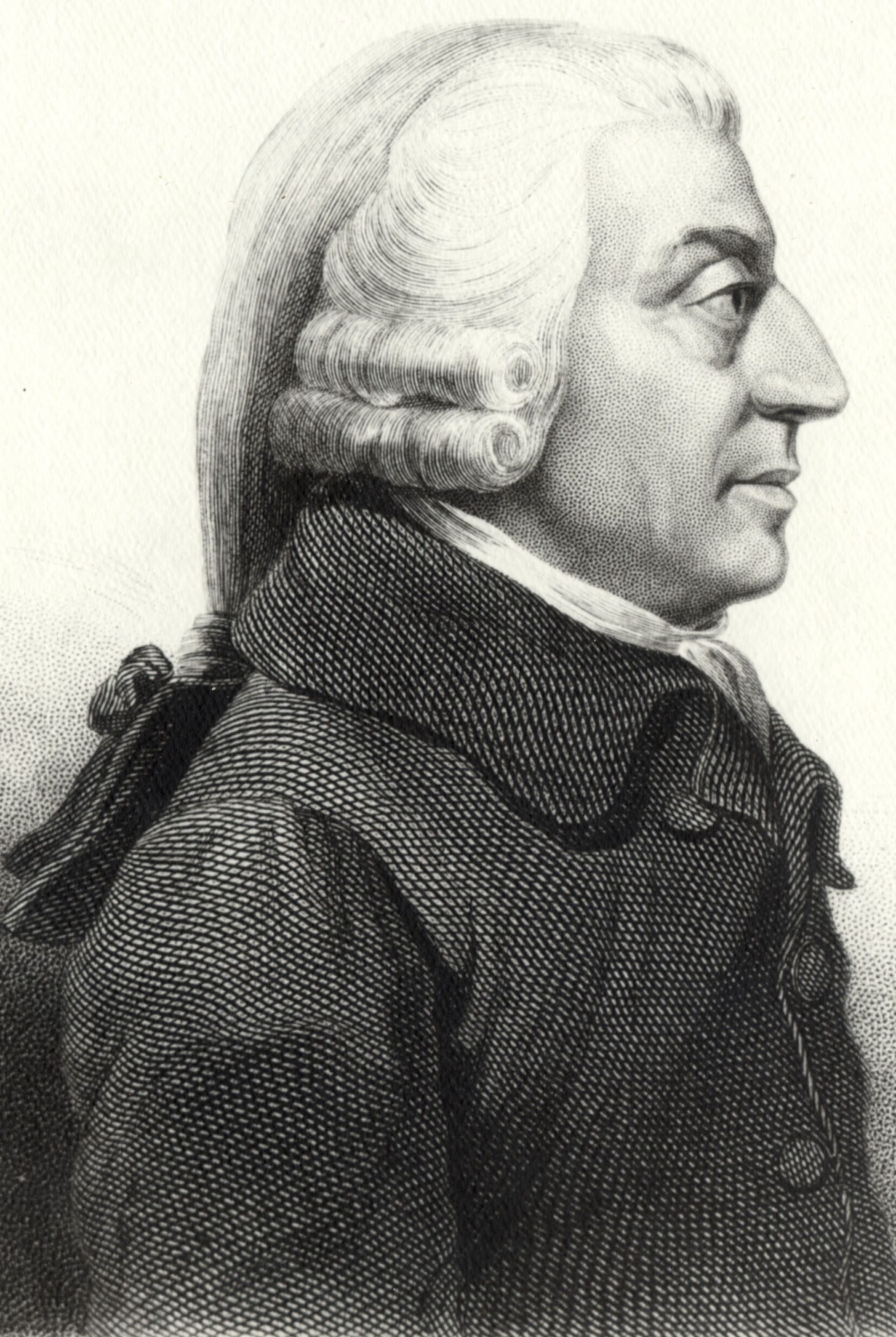
Brief Introduction of Adam Smith
Adam Smith was a Scottish economist, philosopher, and author who is widely regarded as the father of modern economics and a key figure in the Scottish Enlightenment. He is best known for his two seminal works: “The Theory of Moral Sentiments” (1759) and “An Inquiry into the Nature and Causes of the Wealth of Nations” (1776). The latter, often abbreviated as “The Wealth of Nations,” is considered his magnum opus and the first modern work of economics, laying the groundwork for classical free-market economic theory. Smith’s ideas, including the concepts of the “invisible hand,” the division of labor, and the importance of self-interest in driving economic prosperity, have profoundly shaped the world, providing the intellectual foundation for capitalism and influencing generations of economists, politicians, and thinkers.

Adam Smith Overview
| Full Name | Adam Smith |
| Date of Birth | Baptised on June 5, 1723 (O.S.) / June 16, 1723 (N.S.). His exact birthdate is unknown. |
| Age(as of 2025) | Died in 1790 at the age of 67. |
| Birthplace | Kirkcaldy, Fife, Scotland. |
| Profession | Economist, Philosopher, Author. |
| Husband/Wife | Adam Smith never married. |
| Family | His father, also named Adam Smith, was a customs official who died before he was born. He was raised by his mother, Margaret Douglas, the daughter of a landowner. He was an only child. |
| Relationship/Affairs(GF/BF) | Not applicable. Smith never married and there is no definitive record of any romantic relationships, though it is mentioned he had an attachment to a young lady in his youth that did not result in marriage. |
| Net Worth | The modern concept of net worth is not applicable. However, he earned a substantial income from his professorship, a pension from tutoring the Duke of Buccleuch, and his final post as a commissioner of customs, which made him an affluent man by the standards of his time. |
Early Life and Education of Adam Smith
Adam Smith was born in the small coastal town of Kirkcaldy, Scotland, in 1723. The exact date of his birth is unknown, but his baptism was recorded on June 5, 1723. His father, also named Adam Smith, was a respected lawyer and customs official who passed away just months before his son was born. Consequently, Smith was raised by his widowed mother, Margaret Douglas, with whom he shared a close and lifelong bond. As a child, he was known to be of a sickly constitution, requiring his mother’s devoted care. A notable, though perhaps apocryphal, story from his childhood tells of him being briefly abducted by a band of gypsies at the age of three before being rescued by his uncle.
Smith’s formal education began at the Burgh School of Kirkcaldy, where he studied subjects like Latin, mathematics, history, and writing. A prodigious student, he entered the University of Glasgow at the young age of 14, in 1737. At Glasgow, he was profoundly influenced by the moral philosopher Francis Hutcheson, whose teachings helped shape Smith’s own passion for reason, liberty, and free speech. In 1740, Smith was awarded the prestigious Snell Exhibition, a scholarship that enabled him to undertake postgraduate studies at Balliol College, Oxford University. However, Smith found the intellectual atmosphere at Oxford to be stifling and inferior to that of Glasgow, later noting that “the greater part of the public professors have, for these many years, given up altogether even the pretence of teaching.” Despite his disappointment with the formal instruction, he used his six years at Oxford to educate himself, reading widely across literature and philosophy.
Adam Smith’s Career
After leaving Oxford in 1746, Adam Smith returned to Kirkcaldy for two years. In 1748, he began delivering a series of successful public lectures in Edinburgh on rhetoric and belles-lettres. These lectures earned him significant recognition and led to a crucial friendship with the philosopher David Hume, who would become his closest intellectual confidant. The success of his lectures was instrumental in his appointment to the University of Glasgow in 1751, first as the Chair of Logic. The following year, he took over the more prestigious position of Chair of Moral Philosophy, a post he held for over a decade and which he described as the “most useful” and “happiest and most honorable period” of his life.
It was during his professorship at Glasgow that Smith developed and published his first major work, “The Theory of Moral Sentiments” (1759). This book, which explores the foundations of human morality based on sympathy, brought him considerable international acclaim. The success of the book was such that students from across Europe, even as far as Russia, were drawn to Glasgow to learn from him. In 1764, Smith resigned from his professorship to accept a lucrative position as the personal tutor to the young Henry Scott, 3rd Duke of Buccleuch. This role involved embarking on a tour of Europe with the Duke, which proved to be a transformative experience. During his travels in France and Switzerland, he met with leading intellectual figures of the time, including Voltaire, Benjamin Franklin, and the influential French economists known as the Physiocrats, such as François Quesnay and Turgot. These encounters deeply informed his developing economic ideas.
Upon his return to Britain, a generous lifetime pension from the Duke of Buccleuch allowed Smith the financial security to retire to his hometown of Kirkcaldy and dedicate nearly a decade to his magnum opus. In 1776, he published “An Inquiry into the Nature and Causes of the Wealth of Nations.” This groundbreaking work systematically explained the principles of political economy, critiqued the prevailing mercantilist system, and argued for the benefits of free trade, the division of labor, and a market economy guided by individual self-interest. The book was an immediate success, selling out its first edition within six months and cementing Smith’s reputation permanently. In 1778, Smith was appointed as a commissioner of customs in Edinburgh, a seemingly ironic post for a free-trade advocate, which he held until his death. He also received the honor of being elected Lord Rector of the University of Glasgow from 1787 to 1789.
Adam Smith Personal Life & Family
Adam Smith led a quiet, scholarly, and unmarried life. He never had children and maintained a very close relationship with his mother, Margaret Douglas, who raised him from birth following his father’s death. For significant portions of his adult life, he lived with his mother, first in Kirkcaldy while writing “The Wealth of Nations,” and later in Edinburgh after his appointment as customs commissioner, until her death in 1784. His father, Adam Smith Sr., was a customs comptroller who died five months before he was born. Smith had no siblings.
Contemporaries described him as a man of many personal peculiarities, including a famously absent-minded nature, a stumbling manner of speech, and an unusual gait. One anecdote recounts him once falling into a tanner’s pit while engrossed in conversation. Another tells of him putting bread and butter into a teapot, drinking the resulting concoction, and declaring it the worst tea he had ever tasted. Despite these eccentricities, he was also known for his “inexpressible benignity” and was an active member of the vibrant intellectual social circles of Edinburgh. He counted the philosopher David Hume as one of his closest friends. Smith was a dedicated scholar and a true intellectual, once telling a friend, “I am a beau in nothing but my books,” referring to his extensive personal library of around 3,000 volumes. Per his request, the majority of his personal papers and unfinished manuscripts were destroyed after his death on July 17, 1790.

Awards and Achievements of Adam Smith
While Adam Smith lived before the era of numerous formal awards, his achievements were recognized through prestigious academic appointments and the immense influence of his work.
- Chair of Logic, University of Glasgow (1751): Appointed to a professorship at one of Scotland’s leading universities.
- Chair of Moral Philosophy, University of Glasgow (1752): Succeeded his teacher, Francis Hutcheson, in this more esteemed position, which he held for 13 years.
- Publication of “The Theory of Moral Sentiments” (1759): This work established him as a leading moral philosopher of his time and brought him international renown.
- Publication of “The Wealth of Nations” (1776): Considered the foundational text of modern economics, it secured his place as one of the most influential thinkers in history.
- Lord Rector of the University of Glasgow (1787-1789): Elected to this honorary and prestigious position by the students, a testament to his high standing in the academic world.
- Fellow of the Royal Society of London: He was a member of this eminent learned society.
- Founding Member of the Royal Society of Edinburgh (1783): Became a founding member when the Philosophical Society of Edinburgh received its royal charter.
Adam Smith Net Worth and Income
The concept of “Adam Smith net worth” in modern terms is not directly applicable to a figure from the 18th century. However, Adam Smith was financially successful and lived a comfortable life. His income came from several sources. As a popular professor at the University of Glasgow, he earned a respectable salary. His role as tutor to the Duke of Buccleuch from 1764 to 1766 was highly lucrative and came with a generous lifetime pension of £300 per year, which granted him financial independence to focus on his writing. Later in life, his appointment as Commissioner of Customs for Scotland in 1778 provided him with a significant annual income. This combined income made him a very affluent man for his time, allowing him to maintain a large library and live comfortably in Edinburgh.
Legacy and Influence
Adam Smith’s legacy is immense and multifaceted, firmly establishing him as the “Father of Modern Economics” and the “Father of Capitalism.” His work provided the intellectual bedrock for the great 19th-century era of free trade and economic expansion and continues to shape economic thought and policy worldwide. His theories articulated in “The Wealth of Nations”—such as the division of labor, productivity, and the idea that individuals pursuing their own self-interest in a free market can inadvertently promote the greater economic good of society through an “invisible hand”—are now foundational economic principles. He was the first to rigorously argue that a nation’s wealth should be measured not by its hoard of gold and silver (the mercantilist view), but by the total of its production and commerce, a concept that laid the groundwork for modern Gross Domestic Product (GDP).
Smith’s influence extends beyond economics into moral philosophy and political thought. “The Theory of Moral Sentiments” remains a key text in ethics, exploring how conscience and morality arise from social interactions and sympathy. His ideas influenced not only subsequent economists like Karl Marx (who built upon but also critiqued his work), David Ricardo, and John Maynard Keynes, but also political leaders and thinkers who advocated for laissez-faire policies. However, his legacy is also complex; while often portrayed as a champion of pure, unregulated capitalism, Smith recognized the need for government in areas like public education, infrastructure, and the enforcement of justice. He was also deeply concerned with the potential for inequality and the dehumanizing effects of a profit-driven society. His image on the British £20 note from 2007 to 2020 underscores his enduring importance in the United Kingdom and beyond.
Interesting Facts about Adam Smith
- He was briefly kidnapped by gypsies at the age of three but was quickly rescued by his uncle.
- Despite being a key figure of the Scottish Enlightenment, he found the teaching at Oxford University intellectually stifling.
- Smith was known for his extreme absent-mindedness, with many anecdotes from friends and contemporaries detailing his eccentric behavior.
- He never married and lived with his mother for a large part of his adult life.
- Before his death, he ordered that almost all of his private papers and unfinished manuscripts be burned.
- He was the first Scotsman to be featured on a Bank of England banknote, appearing on the £20 note in 2007.
- An asteroid, “12838 Adamsmith,” is named in his honor.
Controversies
A significant intellectual controversy associated with Adam Smith is the “Adam Smith Problem.” This refers to the perceived contradiction between his two major works. In “The Theory of Moral Sentiments,” Smith emphasizes “sympathy”—the human capacity to share the feelings of others—as the foundation of morality. In “The Wealth of Nations,” however, he posits that “self-interest” is the primary driver of economic activity. For many years, scholars debated how the same man could author two books with seemingly opposing views of human nature. Modern scholarship has largely moved to reconcile these views, arguing that the two works are complementary, not contradictory. This perspective suggests that Smith was describing different facets of human behavior that operate in different spheres of life: sympathy governs our personal, moral, and social interactions, while self-interest is the dominant motive in the economic sphere of the marketplace. Smith himself saw no conflict, as he continued to revise “The Theory of Moral Sentiments” even after “The Wealth of Nations” was published, indicating he believed the works were consistent. Another point of contention is the frequent misinterpretation of his work as an argument for completely unregulated, laissez-faire capitalism, ignoring his nuanced views on the essential roles of government and his concerns about the moral character of a commercial society.
Social Media Presence
- Instagram – Not applicable
- Twitter – Not applicable
- YouTube – Not applicable
Final Words about Adam Smith
Adam Smith’s contributions fundamentally changed humanity’s understanding of economics and society. His meticulous analysis of market dynamics in “The Wealth of Nations” did not just describe the nascent capitalist system but provided its core intellectual justification, one that continues to be debated and deployed today. More than just an economist, however, Smith was a profound moral philosopher who grappled with the complexities of human nature. His work was a panoramic inquiry into how individuals, driven by both self-interest and a capacity for sympathy, could create a prosperous and orderly society. While some have selectively used his ideas to justify extreme forms of capitalism, a fuller reading reveals a more nuanced thinker who understood the market’s power but also its potential pitfalls. The enduring relevance of the Adam Smith biography lies in his foundational questions about wealth, morality, and liberty, which remain as critical in the 21st century as they were in the 18th.