
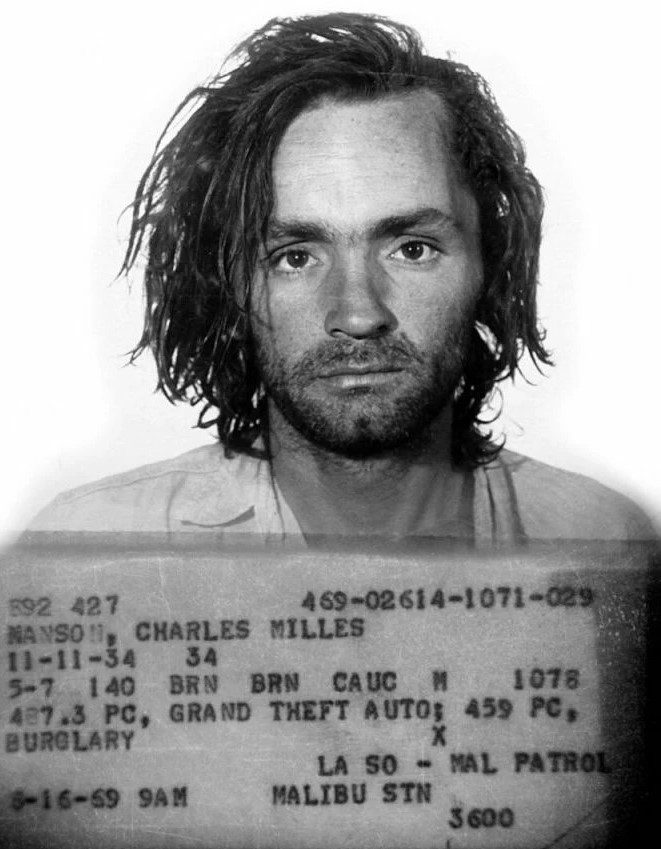
Brief Introduction of Charles Manson
Charles Milles Manson was a notorious American criminal and cult leader who orchestrated a series of brutal murders in the late 1960s. As the leader of the “Manson Family,” a quasi-commune that emerged from the hippie counterculture, he exerted immense psychological control over his followers. Manson is infamous for his role in the Tate-LaBianca murders, a two-night killing spree in August 1969 that claimed the lives of seven people, including the pregnant actress Sharon Tate. Although he did not personally commit the murders, prosecutors successfully argued that his manipulative ideology and direct orders constituted conspiracy to commit murder. His bizarre philosophies, most notably the “Helter Skelter” theory of an apocalyptic race war, and the shocking brutality of the crimes, made him a chilling symbol of the dark side of the 1960s. He spent over four decades in prison, becoming a morbid figure of public fascination until his death.

Charles Manson Overview
| Full Name | Charles Milles Manson (born Charles Milles Maddox) |
| Date of Birth | November 12, 1934 |
| Age (as of 2025) | Deceased (Died at age 83 on November 19, 2017) |
| Birthplace | Cincinnati, Ohio, U.S. |
| Profession | Cult Leader, Criminal, Musician |
| Husband/Wife | Rosalie Jean Willis (m. 1955; div. 1958), Leona Stevens (also known as Candy Stevens) (m. 1959; div. 1963) |
| Family | Mother: Kathleen Maddox; Father: Believed to be Colonel Walker Henderson Scott Sr. |
| Relationship/Affairs(GF/BF) | Mary Brunner (mother of one of his children) and various members of the Manson Family. |
| Net Worth | Estimates at the time of his death ranged up to $400,000, largely from the potential sale of his music, art, and other memorabilia. |
Early Life and Education of Charles Manson
Charles Manson’s early life was marked by instability, neglect, and crime. He was born Charles Milles Maddox on November 12, 1934, in Cincinnati, Ohio, to a 16-year-old single mother, Kathleen Maddox. His biological father was reportedly a man named Colonel Walker Henderson Scott Sr., whom he never knew. Shortly after his birth, his mother married William Eugene Manson, and Charles was given his stepfather’s surname, though the marriage was short-lived.
Manson’s childhood was chaotic and deeply troubled. His mother, who struggled with alcoholism, was often absent. In 1939, when Charles was about five years old, his mother and her brother were sentenced to prison for robbery, and he was sent to live with his aunt and uncle in West Virginia. Though he later described the brief period after his mother’s parole in 1942 as one of the happiest times of his life, this stability did not last. His mother’s transient lifestyle and continued struggles led to Manson being placed in various institutions. At the age of nine, he reportedly set his school on fire. By thirteen, after his mother tried to place him in a foster home, he was sent to the Gibault School for Boys in Indiana, a reform school from which he frequently ran away. This began a pattern of delinquency—including theft, burglary, and auto theft—that would see him spend a significant portion of his youth and early adulthood in correctional facilities. His formal education was minimal and constantly interrupted by his criminal activities and incarcerations. He did, however, learn to read and write in prison, where he also developed an interest in music and learned to play the guitar.
Charles Manson’s Career
Charles Manson’s “career” was not one of conventional employment but rather a life defined by crime and manipulation, culminating in his role as a notorious cult leader. By the time he was 32, Manson had already spent more than half his life in prisons and reformatories for a variety of offenses including auto theft and forging checks. Upon his release from prison in 1967, he moved to San Francisco during the “Summer of Love” and immersed himself in the hippie counterculture.
It was in this environment that Manson began to gather a following, primarily composed of young, impressionable women who were drawn to his charismatic personality and anti-establishment philosophies. This group, which came to be known as the “Manson Family,” lived a communal and nomadic lifestyle, frequently using psychedelic drugs. Manson established himself as a guru, manipulating his followers through a combination of charisma, intimidation, and teachings that blended elements of Scientology, the Bible’s Book of Revelation, and his own bizarre interpretations of Beatles’ songs.
Manson also pursued a career in music. He was a singer-songwriter and, through a chance association with Dennis Wilson of the Beach Boys, gained some access to the fringes of the Los Angeles music industry. The Beach Boys even recorded a version of his song “Cease to Exist” (retitled “Never Learn Not to Love”). However, his hopes of securing a record deal with producer Terry Melcher were ultimately dashed, a rejection that prosecutors later argued played a role in the subsequent murders.
The defining and most horrific phase of Manson’s “career” was orchestrating a series of murders in the summer of 1969. His motive, according to prosecutors, was to trigger an apocalyptic race war he called “Helter Skelter,” a term he borrowed from a Beatles song. He believed the murders, framed to look like they were committed by Black activists, would incite racial tensions and chaos, after which he and his followers would emerge from hiding to rule the new world order. On his orders, members of the Manson Family carried out the brutal Tate-LaBianca murders, as well as the murders of Gary Hinman and Donald “Shorty” Shea. In 1971, Manson was convicted of first-degree murder and conspiracy to commit murder for the deaths of seven people.
Charles Manson Personal Life & Family
Charles Manson’s personal life was as turbulent and unconventional as his criminal history. He was married twice before the formation of the Manson Family. In 1955, he married a waitress named Rosalie Jean Willis, and they had a son, Charles Manson Jr. The marriage ended in divorce while Manson was imprisoned. Charles Manson Jr., who later changed his name to Jay White to distance himself from his father, died by suicide in 1993.
In 1959, Manson married again, this time to a woman named Leona Stevens (reportedly a prostitute also known as Candy Stevens). They had a son, Charles Luther Manson, before divorcing in 1963. The whereabouts of Charles Luther have often been a subject of speculation.
Manson’s most well-known “family” was the cult he formed in the late 1960s. He cultivated an environment of free love and psychological dominance, fathering a third son, Valentine Michael Manson, in 1968 with one of his earliest followers, Mary Brunner. Valentine was later raised by Brunner’s parents under the name Michael Brunner. Within the commune, Manson held absolute authority, manipulating his followers’ beliefs and actions. They saw him as a messianic, Christ-like figure and were devoted to his apocalyptic vision. His lifestyle was nomadic, moving his followers from San Francisco to various locations in and around Los Angeles, eventually settling at Spahn Ranch, a dilapidated movie set. His beliefs were a strange amalgamation of religious prophecy, racial animosity, and pop culture, particularly his obsession with the Beatles’ “White Album,” which he believed contained coded messages about the coming “Helter Skelter.”

Awards and Achievements of Charles Manson
Charles Manson received no official awards or recognized achievements for any positive contributions. His notoriety comes entirely from his criminal activities.
Charles Manson Net Worth and Income
At the time of his death in 2017, estimates of Charles Manson’s net worth varied, with some sources suggesting a potential value of up to $400,000. This wealth was not from conventional earnings but from the commercialization of his infamy. His estate included rights to his music, artwork, letters, and other memorabilia. Several musicians, including Guns N’ Roses and Marilyn Manson, have covered his songs, generating royalties. While incarcerated, Manson was not legally permitted to profit from his crimes, but it has been alleged that a fortune was amassed through the sale of his creations and image via websites operated by his followers. Following his death, his estate, which includes original songs, guitars, and personal belongings, became the subject of a legal battle among several individuals claiming to be his rightful heirs. The value of these assets is largely driven by the morbid curiosity and cult status surrounding his life and crimes.
Legacy and Influence
Charles Manson’s legacy is one of enduring infamy and a symbol of the dark potential of cult dynamics and charismatic manipulation. He and the Manson Family effectively shattered the peace-and-love ethos of the 1960s counterculture, revealing a violent and nihilistic underbelly that horrified the public. The gruesome nature of the Tate-LaBianca murders left an indelible mark on the American psyche, creating a new level of fear and paranoia.
Manson became a cultural icon of evil, insanity, and the macabre. His image and story have been exhaustively documented and fictionalized in countless books, films, documentaries, and songs. The best-selling true-crime book “Helter Skelter” by prosecutor Vincent Bugliosi provided a detailed account of the case that has shaped public understanding of the events for decades. Even after his death, interest in his life and crimes persists, as seen in recent films and television series that continue to explore the Manson phenomenon. His name and the term “Helter Skelter” have become synonymous with apocalyptic violence and the dangers of unchecked psychological influence, ensuring his place as one of the most notorious figures in modern criminal history.
Interesting Facts about Charles Manson
- Despite his reputation as a musician, Manson spent a significant portion of his life institutionalized, having been in and out of correctional facilities for more than half of his 32 years before forming the “Family.”
- He learned to play the guitar while serving a prison sentence and believed he would become a famous musician upon his release.
- Manson had a chance connection with the music industry through Dennis Wilson, the drummer for the Beach Boys. The band even recorded a modified version of one of Manson’s songs, “Cease to Exist,” retitled “Never Learn Not to Love.”
- While in prison, Manson reportedly received more mail than any other inmate in American history, a testament to the morbid fascination he commanded.
- He was denied parole 12 times during his decades of incarceration.
- The swastika tattoo on his forehead was something he carved himself during his trial.
Controversies
The primary and all-encompassing controversy of Charles Manson’s life revolves around his role as the mastermind behind the brutal Tate-LaBianca murders and other killings perpetrated by his followers. Although he was not physically present at the Tate residence, the prosecution’s case centered on the argument that he was guilty of conspiracy to commit murder due to his absolute control and direct orders to the “Family.” The motive for the murders, famously dubbed “Helter Skelter” by the prosecution, remains a subject of debate. The theory holds that Manson hoped to incite a race war by framing the Black Panthers for the murders of wealthy white individuals. However, some researchers and even former “Family” members have suggested other motives, including revenge for a botched drug deal or retaliation against the music industry figures who rejected Manson’s musical aspirations.
Throughout his imprisonment, Manson remained a controversial figure, granting numerous bizarre and often rambling interviews that further cemented his image as a disturbed and manipulative individual. The continued public and media fascination with him, his crimes, and his followers has also been a source of controversy, with many questioning the ethics of giving a platform to such a notorious figure. The legal battles over his estate after his death also brought renewed attention to his dark legacy.
Social Media Presence
- Instagram – Not applicable
- Twitter – Not applicable
- YouTube – Not applicable
Charles Manson had no official social media presence. Any accounts or content are managed by third parties or are archival in nature.
Final Words about Charles Manson
Charles Manson died of natural causes on November 19, 2017, at the age of 83, while serving a life sentence in a California prison. He had been incarcerated since 1971, having been denied parole a dozen times. His death marked the end of a life spent largely behind bars, but it did not end the dark fascination with his story. Manson’s legacy is not one of achievement but of infamy. He remains a chilling case study in criminal psychology, cult leadership, and the manipulation of vulnerable individuals. The “Manson Family” murders are remembered as a pivotal moment that signaled a violent end to the idealism of the 1960s. Even decades after the crimes, the name Charles Manson continues to evoke images of chaos, brutality, and the terrifying power of a single, malevolent will. His story serves as a permanent cautionary tale about the dark fringes of society and the potential for evil to emerge in the most unexpected forms.
 Team Dailly WikiBio