

Brief Introduction of Arthur Hill
Arthur Edward Spence Hill was a distinguished Canadian actor whose career spanned over four decades, leaving an indelible mark on stage, television, and film. Renowned for his thoughtful and subtly powerful performances, Hill was a versatile actor often cast in professional or patrician roles such as doctors, lawyers, and officials. He first gained widespread acclaim and the highest honor in American theatre, a Tony Award, for his portrayal of George in the original 1962 Broadway production of “Who’s Afraid of Virginia Woolf?”. To television audiences, he became a household name as the compassionate defense attorney in the title role of the popular legal drama “Owen Marshall, Counselor at Law,” which aired from 1971 to 1974. Hill’s work was characterized by a reliable intelligence and a calming presence, making him a respected and sought-after character actor in both the United States and Great Britain.
Arthur Hill Overview
| Full Name | Arthur Edward Spence Hill |
| Date of Birth | August 1, 1922 |
| Age(as of 2025) | Would have been 103 (Died in 2006 at age 84) |
| Birthplace | Melfort, Saskatchewan, Canada |
| Profession | Actor |
| Husband/Wife | Peggy Hassard (m. 1942; d. 1998), Anne-Sophie Taraba (m. 2001) |
| Family | Son: Douglas Hill, Daughter: Jennifer Hill |
| Relationship/Affairs(GF/BF) | Information not publicly available. |
| Net Worth | Not publicly available. |
Early Life and Education of Arthur Hill
Arthur Edward Spence Hill was born in the small prairie town of Melfort, Saskatchewan, Canada, on August 1, 1922. His parents were Olin Drake Hill and Edith Georgina (Spence) Hill. Growing up in Canada, Hill’s initial career ambitions were not in the arts but in the field of law. He enrolled at the University of British Columbia with the intention of pursuing a pre-law degree. However, the outbreak of World War II interrupted his studies. Hill patriotically served his country by joining the Royal Canadian Air Force (RCAF), where he worked in the mechanic corps. After the war, he returned to the University of British Columbia and completed his law degree. It was during this period that he discovered a passion for acting. To support himself through school, Hill began performing in radio plays for the Canadian Broadcasting Corporation (CBC). The allure of the stage proved stronger than that of the courtroom, and upon graduating, he decided to pursue acting professionally, studying the craft in Seattle, Washington, before making a pivotal move to England in 1948.
Arthur Hill’s Career
Arthur Hill’s professional acting career began in Great Britain in 1948, where he quickly found work in theatre, BBC radio plays, and television. His London stage debut was in the 1948 production of “Home of the Brave.” He spent nearly a decade honing his craft in England before moving to New York in the mid-1950s to try his hand on Broadway. His Broadway debut came in 1957 when he played Cornelius Hackl in a revival of Thornton Wilder’s “The Matchmaker,” starring alongside Ruth Gordon. This was followed by a role in the original production of “Look Homeward, Angel” (1957).
The defining moment of Hill’s stage career arrived in 1962 when he was cast as George, the beleaguered, put-upon husband opposite Uta Hagen in the original Broadway production of Edward Albee’s searing drama, “Who’s Afraid of Virginia Woolf?”. The play was a cultural phenomenon, and Hill’s performance was universally lauded for its depth and nuance. In 1963, for this iconic role, he won the Tony Award for Best Dramatic Actor, solidifying his reputation as a formidable talent.
Following his stage success, Hill transitioned seamlessly into film and television, moving to Los Angeles in 1968. He became a familiar face to audiences, often playing intelligent and authoritative characters. His notable film credits include roles in “The Ugly American” (1963) with Marlon Brando, the mystery “Harper” (1966) as Paul Newman’s lawyer pal, “Petulia” (1968), and the Cold War thriller “The Chairman” (1969) with Gregory Peck. One of his most memorable film roles was Dr. Jeremy Stone, the no-nonsense lead scientist in the classic science-fiction thriller “The Andromeda Strain” (1971). He also appeared in Sam Peckinpah’s “The Killer Elite” (1975), the sci-fi sequel “Futureworld” (1976), and as a U.S. medical colonel in the epic war film “A Bridge Too Far” (1977).
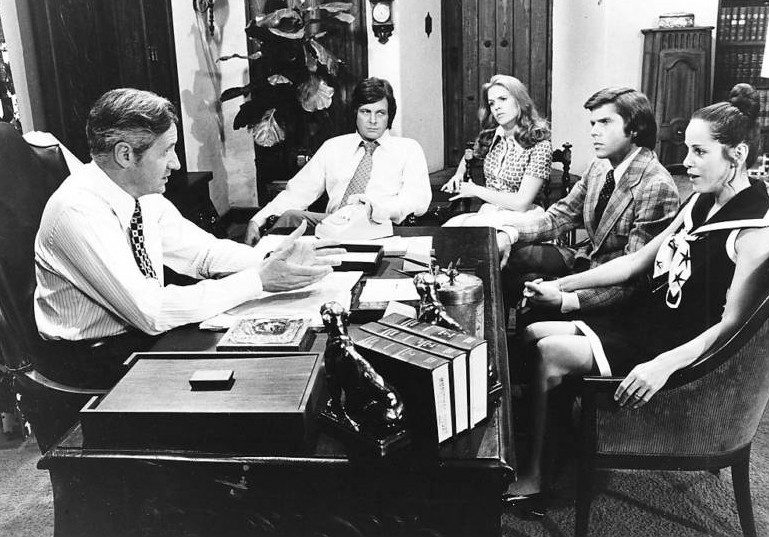
Despite a successful film career, it was television that made Arthur Hill a household name. In 1971, he was cast in the lead role of the legal drama “Owen Marshall, Counselor at Law.” As the wise and compassionate defense attorney, Hill exuded a calming authority that resonated with viewers. The ABC series was highly popular, running for three seasons from 1971 to 1974 and cementing his status as a television star. Throughout the 1970s and 1980s, Hill was a constant presence on television, appearing in numerous made-for-TV movies like “Death Be Not Proud” (1975) and “Judge Horton and the Scottsboro Boys” (1976), and making guest appearances on popular shows such as “Little House on the Prairie,” “Alfred Hitchcock Presents,” and “Mission: Impossible.” He appeared in the very first episode of “Murder, She Wrote” in 1984 and returned for another role in 1990. His final screen appearance was in a 1990 episode of “Columbo” titled “Agenda for Murder,” after which he retired from acting.
Arthur Hill Personal Life & Family
Arthur Hill’s personal life was marked by long-term commitment and stability, largely removed from the glare of Hollywood celebrity. He married his first wife, actress Peggy Hassard, in September 1942. Together, they built a life that spanned continents, moving from Canada to Great Britain in 1948, then to New York City in 1955, and finally settling in Los Angeles in 1968 as his career in American film and television blossomed. The couple had two children, a son named Douglas and a daughter named Jennifer. Their marriage lasted for 56 years, a testament to their enduring bond. Sadly, Peggy passed away in 1998 after a battle with Alzheimer’s disease. In 2001, Hill found companionship again and married Anne-Sophie Taraba, to whom he remained married for the rest of his life. Hill himself would later face a long struggle with Alzheimer’s disease, leading to his death on October 22, 2006, at a care facility in Pacific Palisades, California, at the age of 84. His remains were cremated and his ashes were scattered at sea. For a full Arthur Hill wiki and biography, his journey reflects a man dedicated to both his craft and his family.

Awards and Achievements of Arthur Hill
- Tony Award for Best Dramatic Actor for “Who’s Afraid of Virginia Woolf?” (1963)
- New York Drama Critics’ Circle Award for “Who’s Afraid of Virginia Woolf?” (1962)
Arthur Hill Net Worth and Income
Information regarding the specific details of Arthur Hill’s net worth and income sources is not publicly available. While he had a long and successful career in theatre, film, and television, spanning over 40 years, any estimation of the Arthur Hill net worth at the time of his death in 2006 would be purely speculative. His primary income came from his work as a professional actor. He retired from acting in 1990.
Legacy and Influence
Arthur Hill’s legacy is that of a consummate character actor, a reliable and intelligent performer who elevated every project he was a part of. While he may be best remembered for his Tony-winning tour de force on Broadway in “Who’s Afraid of Virginia Woolf?” and his starring role on television’s “Owen Marshall, Counselor at Law,” his body of work is vast and consistently excellent. He was a versatile actor who could move effortlessly between the stage and the screen, embodying authority, intellect, and a quiet humanity. Colleagues and critics alike respected his professionalism and the thoughtful dedication he brought to his roles. His calming voice and pensive eyes became his trademark, making him a reassuring presence for audiences over several decades. He demonstrated that a successful and enduring career could be built on subtle, truthful performances rather than flashy pyrotechnics, influencing a generation of actors who valued craft over celebrity.
Interesting Facts about Arthur Hill
- Before becoming a celebrated actor, Arthur Hill earned a law degree from the University of British Columbia.
- He served in the mechanic corps of the Royal Canadian Air Force during World War II.
- He won his Tony Award for “Who’s Afraid of Virginia Woolf?” in the same year the play won for Best Play.
- His role as Owen Marshall, a compassionate lawyer, was a natural fit, given his own legal training.
- He narrated the 1983 Disney film “Something Wicked This Way Comes.”
- His final acting role was playing a governor in a 1990 episode of the detective series “Columbo.”
Controversies
Throughout his extensive and public career, Arthur Hill maintained a reputation for professionalism and was not associated with any major public controversies or scandals. He led a relatively private personal life focused on his family and his work.
Social Media Presence
Arthur Hill retired from acting in 1990 and passed away in 2006. His career predated the widespread use of modern social media platforms, and as such, he did not have any official presence on Instagram, Twitter, YouTube, or other similar networks.
Final Words about Arthur Hill
Arthur Hill’s extensive career is a testament to the power of quiet dedication and immense talent. From the Canadian prairies to the stages of London and Broadway, and finally to the screens of Hollywood, he crafted a career built on integrity and versatility. He was an actor’s actor, respected for his craft and beloved by audiences for the intelligence and humanity he brought to every role. Though he passed away in 2006 after a long battle with Alzheimer’s disease, his work endures. Whether as the tormented George in a groundbreaking play or the principled lawyer in a classic television series, Arthur Hill’s performances remain a benchmark of quality. His legacy is not one of fleeting celebrity but of a lasting contribution to the arts, a career defined by memorable characters and an unwavering commitment to storytelling.
 Team Dailly WikiBio