
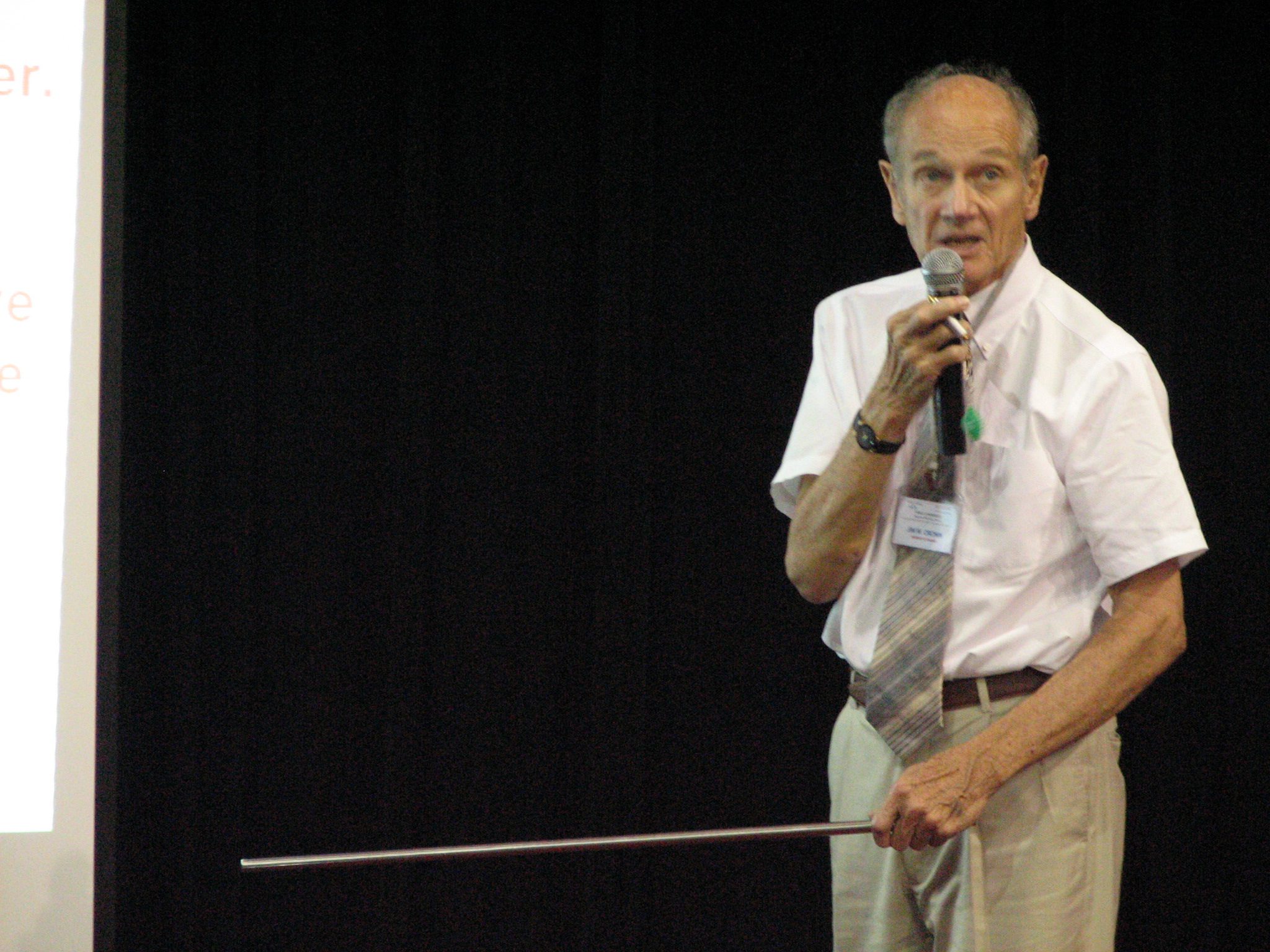
Brief Introduction of James Cronin
James Watson Cronin was a distinguished American particle physicist whose groundbreaking work fundamentally altered our understanding of the laws of nature. He is most renowned for the co-discovery of the violation of CP symmetry (charge-parity symmetry) in the decay of neutral K-mesons. This monumental discovery, made in 1964 alongside his colleague Val Fitch, demonstrated that certain subatomic reactions are not indifferent to the direction of time. This finding had profound implications for our understanding of the universe, particularly the puzzle of why there is a preponderance of matter over antimatter. For this pivotal achievement, Cronin and Fitch were jointly awarded the 1980 Nobel Prize in Physics. Throughout his illustrious career, Cronin was not only a pioneering researcher but also a dedicated educator and a key figure in the establishment of the Pierre Auger Observatory, a major international project to study the highest-energy cosmic rays.

James Cronin Overview
| Full Name | James Watson Cronin |
| Date of Birth | September 29, 1931 |
| Age(as of 2025) | Would have been 94 |
| Birthplace | Chicago, Illinois, U.S. |
| Profession | Particle Physicist |
| Husband/Wife | Annette Martin (m. 1954; died 2005), Carol Champlin (m. 2006) |
| Family | Father – James Farley Cronin, Mother – Dorothy Watson. Children – Cathryn, Emily, and Daniel. |
| Relationship/Affairs(GF/BF) | Information not disclosed. |
| Net Worth | Not publicly available. |
Early Life and Education of James Cronin
James Watson Cronin was born in Chicago, Illinois, on September 29, 1931. His father, James Farley Cronin, was a graduate student of classical languages at the University of Chicago at the time of his birth. Following his father’s academic career, the family moved first to Alabama and then, in 1939, to Dallas, Texas, where the elder Cronin became a professor of Latin and Greek at Southern Methodist University. It was in Dallas that young James completed his primary and secondary education. He attended Southern Methodist University, where he pursued his interest in science, earning an undergraduate degree in physics and mathematics in 1951. For his graduate studies, Cronin returned to his birthplace, Chicago, to attend the prestigious University of Chicago. There, he was taught by some of the most brilliant scientific minds of the 20th century, including Nobel laureates Enrico Fermi, Maria Goeppert Mayer, Murray Gell-Mann, and Subrahmanyan Chandrasekhar. He completed his Ph.D. in physics in 1955, with a thesis on experimental nuclear physics under the supervision of Samuel K. Allison.
James Cronin’s Career
Upon completing his doctorate in 1955, James Cronin embarked on a remarkable career in particle physics. He began his professional journey at the Brookhaven National Laboratory, where he joined the research group of Rodney L. Cool and Oreste Piccioni. It was an exhilarating time in the field, with the recent completion of the Cosmotron particle accelerator. At Brookhaven, Cronin delved into the study of parity violation in the decay of hyperon particles. It was during this period that he met Val Fitch, a pivotal encounter that would shape the course of his career. Fitch invited Cronin to join him at Princeton University in the fall of 1958. Cronin accepted the position and would remain at Princeton for 13 years, progressing from assistant professor to full professor.
The defining moment of Cronin’s career came in 1964, during an experiment conducted at the Alternating Gradient Synchrotron at Brookhaven National Laboratory. Cronin and Fitch were investigating the decay of neutral K-mesons (kaons). At the time, a fundamental principle of physics known as CP symmetry held that the laws of physics should remain the same if a particle were interchanged with its antiparticle (charge conjugation, C) and its spatial coordinates were inverted (parity, P). To their astonishment, Cronin and Fitch’s experiment demonstrated that in a small fraction of cases, the decay of long-lived neutral K-mesons violated this symmetry. This discovery of CP violation was a profound revelation, proving that certain subatomic reactions are not invariant under the reversal of time. The finding had far-reaching implications, offering a crucial piece of the puzzle in explaining the dominance of matter over antimatter in the universe. For this landmark discovery, James Cronin and Val Fitch were jointly awarded the Nobel Prize in Physics in 1980.
Following this monumental discovery, Cronin spent a year in France at the Centre d’Études Nucléaires at Saclay. In 1971, he returned to the University of Chicago as a full professor, attracted by the construction of a new 400 GeV particle accelerator at the nearby Fermilab. There, he continued his research, leading a series of experiments on particle production at high transverse momentum. Later in his career, his scientific interests shifted towards the study of cosmic rays, the highest-energy particles in nature. This led him to co-found the Pierre Auger Observatory, a vast international project in Argentina designed to detect and study ultra-high-energy cosmic rays. Cronin served as a spokesperson emeritus for this ambitious and successful project. He was also a respected educator, earning the University of Chicago’s Quantrell Award for Excellence in Undergraduate Teaching in 1994.
James Cronin Personal Life & Family
James Cronin’s personal life was marked by enduring relationships and a close-knit family. In 1954, while in graduate school at the University of Chicago, he married Annette Martin. Annette was the Director of Special Events at the university. Together, they had three children: two daughters, Cathryn (born in 1955) and Emily (born in 1959), and a son, Daniel (born in 1971). The family provided a stable and supportive foundation for his demanding scientific career. Tragically, Annette passed away in June 2005 due to complications from Parkinson’s disease. In November 2006, Cronin found companionship again and married Carol Champlin. He faced further personal loss in May 2011 when his daughter Cathryn died of leukemia at the age of 54. James Cronin passed away on August 25, 2016, at the age of 84, in Saint Paul, Minnesota.

Awards and Achievements of James Cronin
- Research Corporation Award (1968)
- John Price Wetherill Medal of the Franklin Institute (1975)
- Ernest Orlando Lawrence Award (1976)
- Nobel Prize in Physics (1980)
- Quantrell Award for Excellence in Undergraduate Teaching (1994)
- National Medal of Science (1999)
- Legion d’honneur of France (2001)
- Foreign member of the Royal Society of London (2007)
- University of Chicago Alumni Medal (2013)
James Cronin Net Worth and Income
Information regarding James Cronin’s net worth and income is not publicly available. As an academic and research scientist, his wealth would have primarily been derived from his university salary, prize money from awards such as the Nobel Prize, and any honoraria from lectures and publications. However, specific figures have not been disclosed.
Legacy and Influence
The legacy of James Cronin is etched in the annals of modern physics. His co-discovery of CP violation fundamentally changed our understanding of the symmetries that govern the universe. This breakthrough provided a crucial insight into the matter-antimatter asymmetry, a long-standing puzzle in cosmology. The Cronin-Fitch experiment is considered a classic in the history of particle physics, celebrated for its elegance and profound implications. Beyond this singular achievement, Cronin’s influence extended to the next generation of scientists through his dedicated teaching and mentorship at Princeton and the University of Chicago. His later work in establishing and leading the Pierre Auger Observatory demonstrated his vision and commitment to pushing the frontiers of scientific knowledge. This project has opened a new window onto the cosmos, allowing for the study of the most energetic particles known to exist. The donation of his professional papers and medals, including his Nobel Prize, to the University of Chicago Library ensures that his work will continue to inspire and educate future generations of physicists. James Cronin is remembered as a brilliant experimentalist, a dedicated educator, and a driving force in international scientific collaboration.
Interesting Facts about James Cronin
- His father was a professor of classical languages, a field quite distant from his own scientific pursuits.
- He shared a birthday, September 29th, with the renowned physicist Enrico Fermi, whom he greatly admired and who was one of his professors at the University of Chicago.
- Cronin organized a symposium in 2001 to celebrate the 100th anniversary of Enrico Fermi’s birth and edited the resulting book, “Fermi Remembered.”
- In 2008, he was one of 20 American Nobel laureates in Physics to sign a letter to President George W. Bush, urging for increased funding for basic science research.
- He spent a year in France after his Nobel-winning discovery, during which he learned French and even delivered a lecture in the language at the prestigious Collège de France.
Controversies
There are no known major controversies associated with James Cronin’s scientific career or personal life. He was a highly respected figure in the physics community.
Social Media Presence
- Instagram – Not available
- Twitter – Not available
- YouTube – Not available
Final Words about James Cronin
James Cronin’s life was one of relentless curiosity and profound scientific contribution. His discovery of CP violation not only earned him the highest honor in science, the Nobel Prize, but also opened up new avenues of research that continue to be explored today. His transition from particle physics to astrophysics with the Pierre Auger Observatory showcased his enduring passion for tackling the most challenging questions in science. Even after his official retirement, he remained an active and influential member of the scientific community. His legacy is not only in the groundbreaking data and theories he left behind but also in the collaborative spirit he fostered and the countless students and colleagues he inspired. James Cronin will forever be remembered as a giant of 20th-century physics, whose work fundamentally reshaped our understanding of the universe’s most basic laws.