
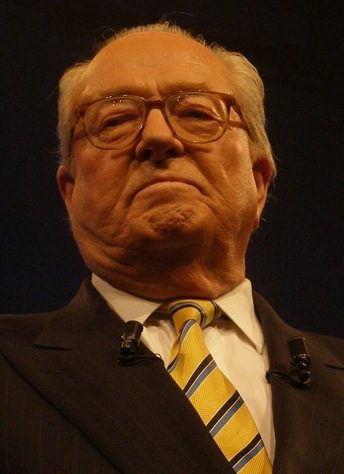
Brief Introduction of Jean Le Pen
Jean-Marie Le Pen was a towering and deeply controversial figure in French politics for over half a century. A former paratrooper, lawyer, and activist, he is best known as the founder of the far-right political party, the Front National (FN), in 1972. He led the party for nearly four decades, transforming it from a fringe movement into a significant, albeit polarizing, force in the French political landscape. Le Pen’s political platform was built on a foundation of staunch nationalism, stringent anti-immigration policies, and euroscepticism. His fiery rhetoric and populist appeal resonated with a segment of the French electorate, leading to notable electoral performances, including his shocking advancement to the second round of the 2002 presidential election. His career was marked by numerous controversies and convictions for statements deemed xenophobic and antisemitic, which ultimately led to his expulsion from the very party he founded.
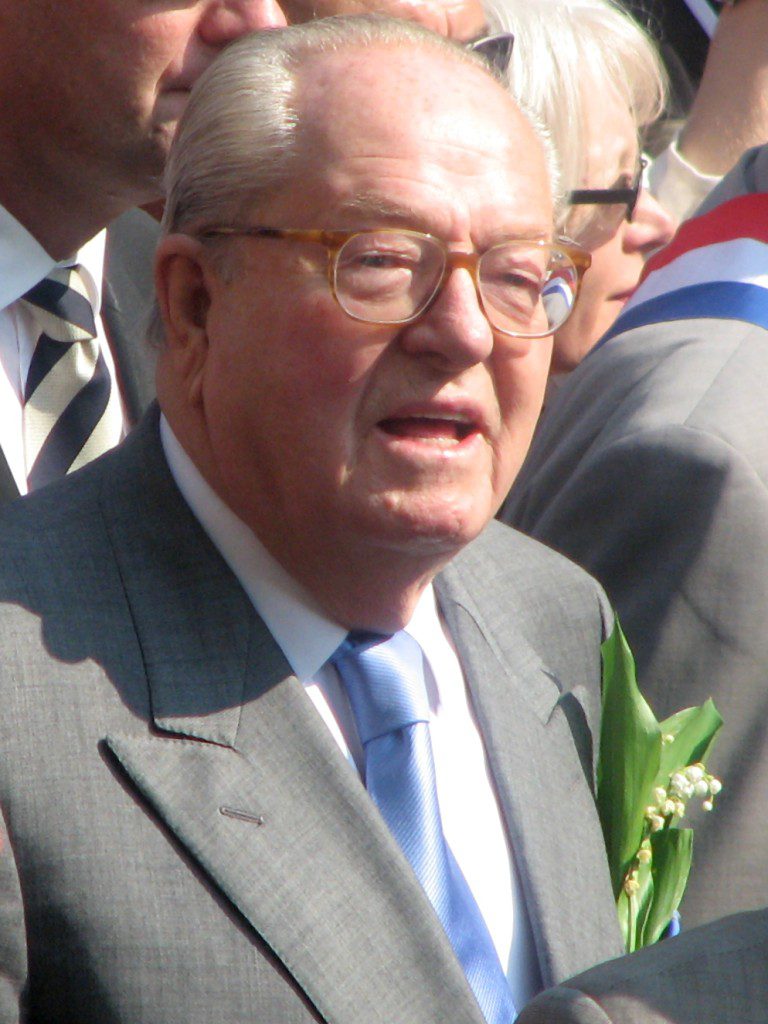
Jean Le Pen Overview
| Full Name | Jean Louis Marie Le Pen |
| Date of Birth | June 20, 1928 |
| Age(as of 2025) | 96 |
| Birthplace | La Trinité-sur-Mer, Morbihan, France |
| Profession | Politician, Lawyer, Activist |
| Husband/Wife | Pierrette Lalanne (m. 1960; div. 1987), Jeanne-Marie “Jany” Paschos (m. 1991) |
| Family | Daughters: Marie-Caroline Le Pen, Yann Le Pen, Marine Le Pen; Granddaughter: Marion Maréchal |
| Relationship/Affairs(GF/BF) | Not publicly available |
| Net Worth | Information not disclosed |
Early Life and Education of Jean Le Pen
Jean Louis Marie Le Pen was born on June 20, 1928, in La Trinité-sur-Mer, a small coastal village in Brittany, France. He was the only son of Jean Le Pen, a fisherman and local councilor, and Anne-Marie Hervé, a seamstress. His early life was marked by tragedy; in 1942, at the age of 14, he became a “Ward of the Nation” (an orphan of war) after his father’s fishing boat, La Persévérance, was destroyed by a mine. This formative experience is often cited as a significant influence on his later nationalist views. Le Pen received his early education at a Jesuit boarding school in Vannes, from which he was reportedly expelled. He later moved to Paris to study law and political science at the University of Paris (Panthéon-Assas). During his university years, he became actively involved in right-wing student politics, leading an association of law students known for engaging in street brawls with communist groups. After completing his law degree, he chose to enlist in the French Foreign Legion.
Jean Le Pen’s Career
Jean Le Pen’s career was a long and tumultuous journey through the heart of French far-right politics. After his university studies, he served as a paratrooper in the French Foreign Legion, seeing action in French Indochina and Algeria during the 1950s. His military service, particularly during the Algerian War, profoundly shaped his anti-decolonization stance.
His political career began in 1956 when he was elected to the National Assembly as the youngest deputy, representing the populist movement led by Pierre Poujade. After a break with Poujade, he was re-elected in 1958 but lost his seat in 1962. For the next decade, he remained active in various far-right circles and even founded a company that sold historical recordings, including Nazi speeches.
The pivotal moment in his career came in 1972 with the founding of the Front National (FN). The party was created to unify disparate elements of the French far-right. Initially, the FN struggled to gain traction, with Le Pen receiving less than one percent of the vote in the 1974 presidential election. However, amidst the economic crises of the 1970s and 1980s, the party’s anti-immigration and nationalist rhetoric began to find a more receptive audience.
The 1980s marked the FN’s breakthrough into the political mainstream. The party achieved significant success in the 1984 European elections and, most notably, won 35 seats in the 1986 legislative elections under a temporary system of proportional representation. Le Pen himself was elected to the European Parliament, a position he would hold for several terms over the subsequent decades.
Le Pen ran for the French presidency five times. His campaigns were characterized by their focus on immigration, national identity, and criticism of the political establishment. While he steadily built a base of support, his most stunning achievement came in the 2002 presidential election. In a result that sent shockwaves through France and Europe, Le Pen finished second in the first round, ahead of the Socialist Prime Minister Lionel Jospin. This victory triggered massive street protests across France against his candidacy. In the second-round runoff, he was decisively defeated by the incumbent, Jacques Chirac, who garnered over 82% of the vote.
Despite this defeat, the 2002 election cemented Le Pen’s status as a major, albeit highly controversial, figure in French politics. He continued to lead the FN until 2011, when he was succeeded by his youngest daughter, Marine Le Pen. He was then given the title of Honorary President. However, his relationship with the party he founded became increasingly strained as Marine sought to “de-demonize” its image. After repeating controversial remarks about the Holocaust, he was suspended and ultimately expelled from the Front National in 2015, a move that symbolized a definitive break with his legacy.
Jean Le Pen Personal Life & Family
Jean Le Pen’s personal life was often as dramatic and public as his political career. He was married twice. His first marriage was to Pierrette Lalanne on June 29, 1960. Together, they had three daughters: Marie-Caroline, Yann, and Marine. All three of his daughters would, to varying degrees, become involved in politics. The marriage ended in a contentious divorce in 1987, famously marked by Pierrette posing nude in Playboy magazine in a gesture meant to ridicule her ex-husband.
His youngest daughter, Marine Le Pen, would go on to succeed him as the leader of the Front National (later renamed National Rally) in 2011, becoming a major political figure in her own right. His granddaughter, Marion Maréchal (daughter of Yann), also became a prominent politician on the French far-right. The family’s political dynasty is a unique feature of French politics. However, Le Pen’s relationship with his daughter Marine became deeply fractured, particularly after she took over the party leadership. Her efforts to detoxify the party’s image led to a public and bitter feud, culminating in his expulsion from the party in 2015.
In 1991, Jean-Marie Le Pen married his second wife, Jeanne-Marie “Jany” Paschos, who was of Greek descent. They remained married until his death.
In 1977, Le Pen’s financial situation changed dramatically when he inherited a significant fortune, including a mansion in Saint-Cloud, from Hubert Lambert, a wealthy cement industrialist and political supporter. This inheritance provided him with the financial means to fund his political activities for many years. His personal life was also marked by security concerns; in 1976, his Parisian apartment was bombed, though the crime was never solved. In his later years, Le Pen faced declining health, and in April 2024, he was placed under legal protection at the request of his family.
Awards and Achievements of Jean Le Pen
- Cross for Military Valour (Croix de la Valeur militaire)
- Combatant’s Cross (Croix du combattant)
- Indochina Campaign commemorative medal (Médaille commémorative de la campagne d’Indochine)
- North Africa Security and Order Operations commemorative medal (Médaille commémorative des opérations de sécurité et de maintien de l’ordre en Afrique du Nord)
- Suez commemorative medal (Médaille commémorative du Moyen-Orient)
Jean Le Pen Net Worth and Income
Information regarding Jean Le Pen’s precise net worth is not publicly disclosed. A significant part of his wealth originated from a large inheritance he received in 1977 from Hubert Lambert, the heir to a cement fortune. This inheritance included an estate valued at millions of dollars and a mansion in the Parisian suburb of Saint-Cloud, which became his home and a political base. Throughout his long political career, he also received income as a Member of the National Assembly and, for many years, as a Member of the European Parliament. He also founded a company in the 1960s to sell historical recordings. However, detailed and updated figures on his total assets and income sources remain private.

Legacy and Influence
Jean Le Pen’s legacy is profound, complex, and deeply divisive. For over four decades, he was the central figure of the French far-right, shaping its ideology and bringing its core issues of immigration, national identity, and euroscepticism from the fringes into the mainstream of political discourse. He possessed a formidable political talent, combining populist charisma with inflammatory rhetoric to build a durable electoral base. His most significant political achievement was arguably his second-place finish in the 2002 presidential election, a moment that remains a defining trauma in modern French politics, often referred to as the “shock of April 21st.”
His influence extends far beyond his own electoral results. By consistently hammering on themes that mainstream parties often ignored, he forced a national conversation on immigration and identity, shifting the entire political spectrum to the right. The party he created, now the National Rally under his daughter Marine’s leadership, has become one of France’s most powerful political forces, a direct result of the foundations he laid. However, his legacy is inextricably linked to the numerous controversies and convictions for racism and antisemitism that marked his career. His repeated dismissal of the Holocaust’s gas chambers as a “detail” of history is one of the most infamous examples. For his opponents, he is remembered as the “Devil of the Republic,” a figure who legitimized xenophobia and division in France. For his supporters, he was a patriot who dared to speak uncomfortable truths. Ultimately, Jean Le Pen reshaped the French political landscape, leaving behind a powerful and enduring, yet deeply contested, legacy.
Interesting Facts about Jean Le Pen
- He became an orphan and “Ward of the Nation” at age 14 after his fisherman father’s boat was blown up by a mine during World War II.
- In 1956, he was elected to the National Assembly as its youngest member at the time.
- He lost an eye in 1965 in a violent brawl while campaigning for a far-right presidential candidate.
- A bomb targeting him exploded outside his family’s apartment in 1976 when his daughter Marine was eight years old.
- His first wife, Pierrette Lalanne, posed for Playboy magazine after their acrimonious divorce.
- He was an avid breeder of Doberman pinschers.
- He inherited a substantial fortune and a mansion in 1977 from a wealthy political supporter, which financed his political activities for years.
Controversies
Jean Le Pen’s political career was defined by a long and extensive series of controversies and legal convictions. He was repeatedly accused and found guilty of inciting racial hatred, xenophobia, and antisemitism. One of his most notorious and repeated statements was his description of the Nazi gas chambers as a “detail” in the history of World War II, a comment for which he was convicted multiple times for Holocaust denial. He was also convicted for claiming the German occupation of France was not “particularly inhumane.” In the 1960s, he received a suspended prison sentence for an “apology of war crimes.” Le Pen was also accused of participating in acts of torture during his time as an intelligence officer in the Algerian War, allegations which he always denied. In his later years, he made inflammatory remarks suggesting the Ebola virus could solve Europe’s immigration issues. These and many other incendiary comments not only led to numerous court battles but also fueled the public perception of him as a dangerous extremist and ultimately led to the dramatic rupture with his daughter Marine and his expulsion from the National Front in 2015.
Social Media Presence
- Instagram – Not publicly available
- Twitter – Not publicly available
- YouTube – Not publicly available
Final Words about Jean Le Pen
Jean-Marie Le Pen remained a vocal, albeit increasingly marginalized, figure even after his expulsion from the National Rally. He founded a new political association, the Comités Jeanne, and continued to comment on French politics, often in opposition to the direction taken by his daughter. His relationship with Marine remained publicly acrimonious, a family feud that played out in the national media. In his final years, he suffered from declining health, including several heart attacks, and was placed under the legal guardianship of his daughters. Jean-Marie Le Pen passed away on January 7, 2025, at the age of 96. His death closed a long and tumultuous chapter in French history. He leaves behind a transformed political landscape where the far-right, once a fringe element he brought to the forefront, is now a central and powerful force. His legacy is one of profound political impact married to deep controversy, ensuring that his role in shaping contemporary France will be debated for generations to come.