

Brief Introduction of George Bush
George Walker Bush, an American politician and businessman, served as the 43rd President of the United States from 2001 to 2009. His presidency was profoundly shaped by the September 11, 2001 terrorist attacks, which led to the declaration of a global “war on terror,” the invasion of Afghanistan, and the controversial 2003 invasion of Iraq. Before entering the White House, Bush, the eldest son of the 41st U.S. President, George H. W. Bush, built a career in the oil industry and was a co-owner of the Texas Rangers baseball team. He served as the 46th Governor of Texas from 1995 to 2000. His time in office was marked by significant domestic policies, including the No Child Left Behind Act for education reform and major tax cuts. George W. Bush’s presidency remains a subject of intense debate and study, defined by its response to terrorism, its foreign policy decisions, and its impact on the American economy and society.
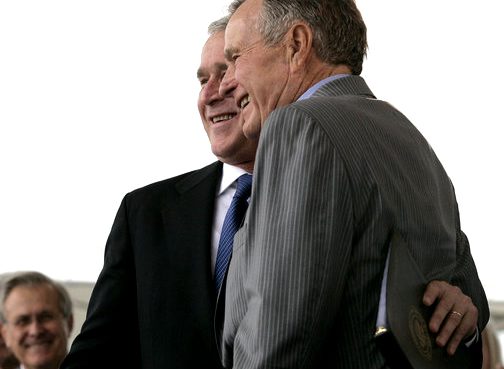
George Bush Overview
| Full Name | George Walker Bush |
| Date of Birth | July 6, 1946 |
| Age(as of 2025) | 79 |
| Birthplace | New Haven, Connecticut, U.S. |
| Profession | Politician, Businessman |
| Husband/Wife | Laura Welch (married 1977) |
| Family | Parents: George H. W. Bush and Barbara Bush. Siblings: Jeb, Neil, Marvin, and Dorothy. Children: Barbara and Jenna (fraternal twins). |
| Relationship/Affairs(GF/BF) | Not publicly available |
| Net Worth | Estimated to be between $40 million and $50 million. |
Early Life and Education of George Bush
George Walker Bush was born on July 6, 1946, in New Haven, Connecticut, into a family with a burgeoning legacy in public service. He was the first child of George Herbert Walker Bush, who would become the 41st U.S. President, and Barbara Pierce Bush. Soon after his birth, the family moved to Texas, where the elder Bush entered the oil industry, and George W. Bush spent most of his childhood in the cities of Midland and Houston. His upbringing was marked by family tragedy when his younger sister, Robin, died of leukemia in 1953 at the age of three. He has four other siblings: Jeb, Neil, Marvin, and Dorothy. Bush’s education took him to prestigious institutions. After attending primary schools in Texas, he followed in his father’s footsteps to Phillips Academy in Andover, Massachusetts, a preparatory boarding school. At Phillips, he was an athlete and, in his senior year, the head cheerleader. In 1964, he entered Yale University, his father’s and grandfather’s alma mater. At Yale, he studied history, was a member of the Delta Kappa Epsilon fraternity, and was inducted into the secretive Skull and Bones society as a senior. He graduated with a Bachelor of Arts degree in 1968. During the Vietnam War, in May 1968, Bush joined the Texas Air National Guard, where he was trained as an F-102 fighter pilot, serving until his honorable discharge in 1974. Following his military service, he attended Harvard Business School, earning a Master of Business Administration (M.B.A.) degree in 1975, making him the only U.S. president to have earned this degree.
George Bush’s Career
After graduating from Harvard, George W. Bush returned to Midland, Texas, and began a career in the energy business, founding his own oil and gas firm, Arbusto Energy, in the late 1970s. His first foray into politics was an unsuccessful campaign for the U.S. House of Representatives in 1978. He later worked on his father’s successful 1988 presidential campaign as a senior advisor. A significant career shift occurred in 1989 when Bush assembled a group of investors to purchase the Texas Rangers Major League Baseball franchise. As managing general partner, he became a public face for the team, a role that significantly raised his profile across the state. In 1994, leveraging this recognition, Bush ran for Governor of Texas against the popular incumbent, Ann Richards. Campaigning on a platform of “compassionate conservatism,” which included promises of education reform, tort reform, and welfare reform, he won a surprising victory. As governor, he enacted significant legislation, including a major tax cut and policies that made Texas a leader in wind power energy production. His bipartisan approach and popularity led to a landslide re-election in 1998, making him the first Texas governor to be elected to two consecutive four-year terms. This success positioned him as a leading contender for the 2000 Republican presidential nomination. Bush’s 2000 presidential campaign against Democratic Vice President Al Gore was one of the closest and most controversial in U.S. history. The election outcome hinged on a disputed vote count in Florida, ultimately decided by the U.S. Supreme Court in the case of Bush v. Gore, which stopped the recount and awarded Florida’s electoral votes, and thus the presidency, to Bush. Though he lost the popular vote, he won the Electoral College. His presidency began with a focus on domestic issues, securing a $1.3 trillion tax cut and passing the No Child Left Behind Act. However, the trajectory of his administration was irrevocably altered by the September 11, 2001 terrorist attacks. In response, Bush declared a global “war on terror,” launching an invasion of Afghanistan to overthrow the Taliban regime that harbored al-Qaeda. He created the Department of Homeland Security and signed the controversial USA PATRIOT Act to expand surveillance powers. In 2003, Bush ordered the invasion of Iraq, arguing that Saddam Hussein’s regime possessed weapons of mass destruction (WMDs) and posed a threat, a claim that was later proven to be unfounded. Bush won re-election in 2004 against Democrat John Kerry. His second term was dominated by the ongoing wars in Iraq and Afghanistan, his administration’s much-criticized response to Hurricane Katrina in 2005, and the onset of the Great Recession in late 2007. During this term, he also appointed two conservative justices to the Supreme Court, John Roberts and Samuel Alito. He left office in January 2009, returning to Texas.
George Bush Personal Life & Family
George W. Bush comes from a prominent family deeply rooted in American politics and business. His grandfather, Prescott Bush, was a U.S. Senator from Connecticut, and his father, George H. W. Bush, served as the 41st President of the United States. In 1977, friends introduced him to Laura Welch, a schoolteacher and librarian, at a backyard barbecue. After a three-month courtship, they married that same year. Laura Bush’s calm and reserved demeanor was often seen as a complement to her husband’s more outgoing personality. In 1981, they welcomed fraternal twin daughters, Barbara and Jenna. A pivotal moment in Bush’s personal life occurred in 1986, when, on his 40th birthday, he gave up drinking alcohol and deepened his commitment to his Christian faith, which he has cited as a profound influence on his life. After his presidency, Bush and his wife settled in Dallas, Texas, and also spend time at their ranch in Crawford. In his post-presidency, Bush has taken up oil painting, creating portraits of world leaders, military veterans, and immigrants, and has published books of his artwork. His daughters have also remained in the public eye; Jenna Bush Hager is a co-host on NBC’s “Today” show. The couple are now grandparents.
Awards and Achievements of George Bush
- Presidential Medal of Freedom: While in office, he presented this award, the nation’s highest civilian honor, to numerous distinguished individuals.
- No Child Left Behind Act of 2001: A major, bipartisan education reform bill that increased federal standards and accountability in schools.
- President’s Emergency Plan for AIDS Relief (PEPFAR): A landmark global health initiative launched in 2003, credited with saving millions of lives, particularly in Africa, by providing funding for AIDS prevention, treatment, and care.
- Medicare Modernization Act of 2003: Created the Medicare Part D prescription drug benefit for seniors.
- Tax Cuts: Signed into law major tax relief packages in 2001 and 2003, representing some of the largest tax cuts in decades.
- Creation of the Department of Homeland Security: Oversaw the largest reorganization of the federal government since World War II in response to the 9/11 attacks.
George Bush Net Worth and Income
As of 2025, George W. Bush’s net worth is estimated to be between $40 million and $50 million. His wealth is derived from a variety of sources throughout his life. Before entering politics, he had a career in the oil and gas industry in Texas. A particularly profitable venture was his co-ownership of the Texas Rangers baseball team. In 1989, he was part of an investment group that bought the team, and his initial investment of around $600,000 grew significantly by the time the team was sold. Since leaving the presidency in 2009, Bush has generated substantial income through speaking engagements. He is a highly sought-after speaker, reportedly earning between $100,000 and $175,000 per appearance. He has also authored several successful books, including his 2010 memoir “Decision Points,” for which he received a multi-million dollar advance. Further income comes from his presidential pension and investments. His family’s wealth, originally built in the oil industry, has also contributed to his financial standing.

Legacy and Influence
The legacy of George W. Bush is one of the most debated of any modern president. His tenure is overwhelmingly defined by his response to the September 11th attacks. His immediate crisis leadership was widely praised, and he achieved a record 90% approval rating as he unified the nation. The subsequent “war on terror” reshaped American foreign policy for decades, leading to the longest war in U.S. history in Afghanistan and the highly controversial invasion of Iraq. The Iraq War, predicated on faulty intelligence about weapons of mass destruction, deeply divided the country and damaged America’s international standing. His administration’s policies on enhanced interrogation techniques and domestic surveillance under the Patriot Act sparked enduring debates about the balance between national security and civil liberties. Domestically, his “compassionate conservative” agenda led to significant legislation. The No Child Left Behind Act implemented major changes in education with an emphasis on standardized testing. His large tax cuts were a cornerstone of his economic policy but also contributed to growing federal deficits. Perhaps his most universally acclaimed achievement is the President’s Emergency Plan for AIDS Relief (PEPFAR), a massive humanitarian effort credited with saving millions of lives in Africa. Critics point to the administration’s handling of Hurricane Katrina and the financial crisis of 2008 as major failures. His appointments of Chief Justice John Roberts and Justice Samuel Alito have had a long-lasting conservative impact on the Supreme Court. Ultimately, George W. Bush is viewed as a consequential and transformative president whose decisions continue to influence American politics, foreign policy, and national identity.
Interesting Facts about George Bush
- He is the only U.S. president to have earned an M.B.A. degree.
- Before becoming president, he was a part-owner of the Texas Rangers baseball team.
- During his time at Phillips Academy and Yale University, he was a cheerleader.
- He is the second son of a president to also become president, following John Quincy Adams, son of John Adams.
- In 2005, a man threw a live grenade at him during a rally in Tbilisi, Georgia, but it failed to detonate.
- In his post-presidency, he has become an avid painter, focusing on portraits of world leaders, veterans, and immigrants.
Controversies
George W. Bush’s presidency was marked by numerous significant controversies. The 2000 presidential election itself was a major point of contention, with the Supreme Court’s 5-4 decision in Bush v. Gore halting a Florida recount and effectively deciding the election in his favor. The primary controversy of his tenure was the 2003 invasion of Iraq. The administration’s justification for the war, primarily the claim that Iraq possessed weapons of mass destruction (WMDs), was later found to be based on flawed intelligence. The failure to find WMDs led to accusations that the administration misled the public. The handling of the Iraq War, its rising casualties, and the emergence of an insurgency became deeply unpopular. The administration’s response to the 9/11 attacks also generated controversy, particularly the authorization of “enhanced interrogation techniques,” which critics condemned as torture, and the establishment of the Guantanamo Bay detention camp. The passage of the USA PATRIOT Act was criticized by civil liberties advocates for its expansion of government surveillance powers. In 2005, the federal government’s slow and ineffective response to Hurricane Katrina, which devastated New Orleans, drew widespread condemnation and damaged Bush’s approval ratings. Another significant issue was the 2006 dismissal of several U.S. attorneys, which critics alleged was politically motivated, leading to the resignation of Attorney General Alberto Gonzales.
Social Media Presence
- Instagram – Information not disclosed.
- Twitter – Information not disclosed.
- YouTube – Information not disclosed.
Final Words about George Bush
In the years since leaving the White House, George W. Bush has maintained a relatively low public profile, focusing on his work at the George W. Bush Presidential Center in Dallas. The center includes his presidential library and a public policy institute that works on issues such as economic growth, education reform, global health, and human freedom. He has largely refrained from criticizing subsequent administrations, choosing instead to express himself through his painting and writing. He has published memoirs and books of his artwork, offering his perspective on the critical moments of his presidency and honoring America’s veterans. His public image has softened for some, as he has embraced the role of a political elder statesman, often seen sharing friendly moments with figures from across the political spectrum. However, his presidency’s legacy, particularly the Iraq War and the response to terrorism, remains a powerful and divisive topic in American discourse. His two terms in office represent a pivotal period in American history, and the full impact of his decisions continues to unfold and be evaluated.