
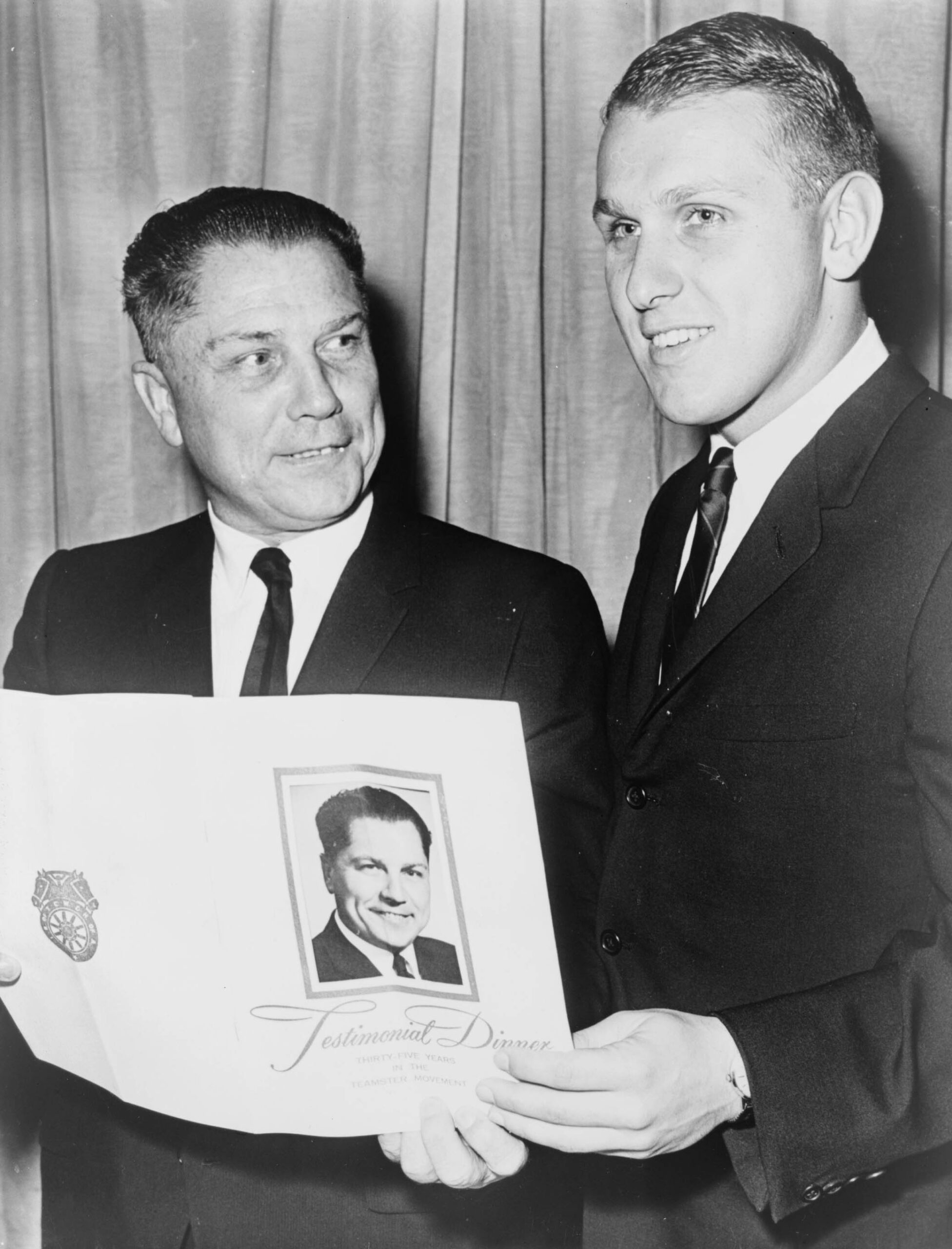
Brief Introduction of Jimmy Hoffa
James Riddle “Jimmy” Hoffa was an American labor union leader who served as the President of the International Brotherhood of Teamsters (IBT) from 1957 to 1971. He was a pivotal figure in the American labor movement, known for his relentless efforts to improve the wages and working conditions of truck drivers and other workers. Under his leadership, the Teamsters became the largest and most powerful union in the United States, with its membership peaking at over 2.3 million. Hoffa’s career was marked by both significant achievements for American workers and persistent allegations of corruption and connections to organized crime. His life came to a mysterious end when he disappeared in July 1975, a case that remains one of the most famous unsolved mysteries in American history. He was declared legally dead in 1982.

Jimmy Hoffa Overview
| Full Name | James Riddle Hoffa |
| Date of Birth | February 14, 1913 |
| Age(as of 2025) | Would have been 112 years old |
| Birthplace | Brazil, Indiana, U.S. |
| Profession | Labor Union Leader |
| Husband/Wife | Josephine Poszywak (m. 1936) |
| Family | Son: James P. Hoffa, Daughter: Barbara Ann Crancer |
| Relationship/Affairs(GF/BF) | Not publicly available |
| Net Worth | Estimated to be around $13 million at the time of his disappearance (adjusted for inflation) |
Early Life and Education of Jimmy Hoffa
James Riddle Hoffa was born in Brazil, Indiana, on February 14, 1913, to John and Viola Hoffa. His father, a coal miner, died from a work-related lung disease when Hoffa was just seven years old, a formative event that exposed him to the harsh realities faced by working-class families. This early hardship deeply influenced his later advocacy for workers’ rights. In 1924, his mother moved the family to Detroit in search of better employment opportunities. Hoffa’s formal education was brief; he left school at the age of 14 to begin working full-time in manual labor jobs to help support his family. His early work experiences, particularly at a Kroger grocery store warehouse, were characterized by low wages and poor working conditions, which spurred his initial involvement in labor organizing.
Jimmy Hoffa’s Career
Jimmy Hoffa’s career in the labor movement began in his teenage years. While working at a Kroger warehouse, he demonstrated his natural leadership abilities by organizing his first successful strike at the age of 19. This early victory caught the attention of the International Brotherhood of Teamsters, which he joined in 1933. Hoffa quickly rose through the ranks, becoming the business agent for Local 299 in Detroit. His ambition, charisma, and aggressive tactics proved effective in expanding the union’s membership and influence.
By 1952, Hoffa had become the national vice-president of the IBT. He ascended to the presidency of the entire union in 1957, succeeding Dave Beck. As president, Hoffa worked tirelessly to consolidate the power of the union. His most significant achievement was the creation of the National Master Freight Agreement in 1964, which brought nearly all over-the-road truck drivers in North America under a single contract, leading to vastly improved wages and working conditions for hundreds of thousands of workers. Under his leadership, the Teamsters’ membership swelled to its highest numbers, making it a formidable force in American politics and economics.
However, Hoffa’s career was also plagued by controversy. From his early days as an organizer, he cultivated relationships with figures in organized crime, which he used to his advantage in union battles. These connections drew the attention of federal law enforcement, leading to a long-running and very public feud with Robert F. Kennedy, who served as chief counsel for the Senate Labor Rackets Committee and later as Attorney General. In 1964, Hoffa was convicted of jury tampering, attempted bribery, and fraud. He began serving a 13-year prison sentence in 1967.
In 1971, President Richard Nixon commuted Hoffa’s sentence on the condition that he not participate in any union activities until 1980. Upon his release, Hoffa began a determined effort to challenge this restriction and reclaim the presidency of the Teamsters. It was during this campaign that he mysteriously disappeared on July 30, 1975, from the parking lot of the Machus Red Fox restaurant in Bloomfield Township, Michigan, where he was scheduled to meet with two mob-connected individuals.
Jimmy Hoffa Personal Life & Family
In 1936, Jimmy Hoffa married Josephine Poszywak, a Detroit laundry worker he met during a strike. They remained married until her death in 1980. The couple had two children: a daughter, Barbara Ann Crancer, who went on to become a judge, and a son, James P. Hoffa. Following in his father’s footsteps, James P. Hoffa served as the General President of the International Brotherhood of Teamsters from 1999 to 2022. The Hoffa family also had a foster son, Charles “Chuckie” O’Brien, who was a close associate of Jimmy’s and a figure of interest in his disappearance. The family lived a relatively modest life in Detroit, and despite his powerful position, Hoffa was known for his accessibility to rank-and-file union members. His personal life was largely intertwined with his all-consuming dedication to the Teamsters union. His children have been vocal over the years in seeking answers and pushing for further investigation into their father’s disappearance.

Awards and Achievements of Jimmy Hoffa
- National Master Freight Agreement (1964): This was Hoffa’s crowning achievement, uniting over 400,000 truck drivers under a single national contract, which significantly improved wages, benefits, and working conditions across the industry.
- Growth of the Teamsters Union: Under his presidency, the Teamsters became the largest labor union in the United States, with membership reaching over two million workers.
- Inducted into Labor’s International Hall of Fame (1999): Posthumously recognized for his impact on the American labor movement.
Jimmy Hoffa Net Worth and Income
At the time of his disappearance in 1975, Jimmy Hoffa’s net worth was a subject of considerable speculation. Upon his release from prison in 1971, he received a one-time lump sum pension settlement from the Teamsters valued at $1.75 million. Adjusted for inflation, this would be equivalent to approximately $13 million in 2025. His wealth was officially derived from his leadership position within the union. However, federal investigations and widespread belief suggested that his net worth was augmented through his connections with organized crime and the alleged misuse of the union’s massive pension funds. The Teamsters’ pension fund, which grew to over $8 billion under his control, was reportedly used to make improper loans and finance mob-controlled ventures, such as casinos in Las Vegas.
Legacy and Influence
Jimmy Hoffa left a complex and enduring legacy. To his supporters and many union members, he was a hero of the working class who fought tirelessly to improve their lives. He is credited with transforming the trucking industry and making the Teamsters a powerful force for economic justice. His leadership led to tangible benefits for millions of American families. However, his legacy is irrevocably tarnished by his deep ties to organized crime and his criminal convictions. This dark side of his leadership led to increased federal scrutiny of labor unions and contributed to a public perception of corruption within the labor movement. The mysterious circumstances of his disappearance have cemented his place in American folklore, often overshadowing his legitimate accomplishments as a labor leader. His life story has been the subject of numerous books, films, and documentaries, ensuring his name remains a subject of public fascination.
Interesting Facts about Jimmy Hoffa
- He was reportedly given the nickname “The Tumor” by the doctor who delivered him, who initially thought his mother had a tumor rather than being pregnant.
- Despite leading a union of truck drivers, Hoffa himself never worked as one.
- During one of his trials, famed boxer Joe Louis testified as a character witness, though it was later suggested they barely knew each other.
- His feud with Robert F. Kennedy was legendary, with the two engaging in explosive confrontations during Senate hearings that were broadcast nationally.
- The search for his remains has been one of the longest and most extensive in U.S. history, with the FBI investigating countless tips and potential burial sites over several decades, all without success.
Controversies
Jimmy Hoffa’s career was rife with controversy, primarily stemming from his entanglement with organized crime and his battles with law enforcement. The McClellan Committee hearings in the late 1950s publicly exposed the extent of corruption and mob influence within the Teamsters under his leadership. Hoffa was the subject of numerous federal investigations throughout his tenure as president. In 1964, his legal troubles culminated in two separate convictions: one for jury tampering in Tennessee and another for mail and wire fraud related to the improper use of the Teamsters’ pension fund. He was sentenced to a combined 13 years in federal prison. His commutation by President Nixon in 1971 was also controversial, with allegations that it was a political deal in exchange for the Teamsters’ support of Nixon’s re-election. The ultimate controversy, of course, is his disappearance, which is widely believed to have been a mob hit orchestrated to prevent him from regaining control of the union and its lucrative pension fund.
Social Media Presence
- Instagram – Not publicly available
- Twitter – Not publicly available
- YouTube – Not publicly available
Final Words about Jimmy Hoffa
Jimmy Hoffa remains one of the most enigmatic and polarizing figures in 20th-century American history. His life was a study in contradictions: a champion of the working man who associated with criminals, a dedicated family man who was embroiled in a life of danger, and a powerful leader whose ultimate fate became a national obsession. Decades after his disappearance, the search for answers continues, and his story serves as a potent reminder of the complex interplay between power, labor, and crime in American society. His legacy is not simply one of accomplishment or corruption, but a lasting narrative of ambition and mystery that continues to captivate the public imagination. While the final chapter of his life may never be definitively written, his impact on the American labor movement is undeniable.